

In 1753, an Act of Parliament created the world’s first free, national public museum. In 1759, it opened its doors to “all studious and curious persons.”
The 1753 act purchased the collection of Sir Hans Sloane, who had more than 80,000 “natural and artificial rarities”, a library of over 40,000 books, and 32,000 coins and medals. The Cotton, Harley, and Royal Libraries were added to this, becoming the British Museum. Since then, the Museum’s collections have grown to roughly 8 million objects “covering two million years of human history”.
The Museum is famous (and somewhat controversial) for housing the Rosetta Stone and the Elgin Marbles of the Parthenon, among many other items.
I only saw a small portion of the Museum on this visit, but here are some of the highlights.
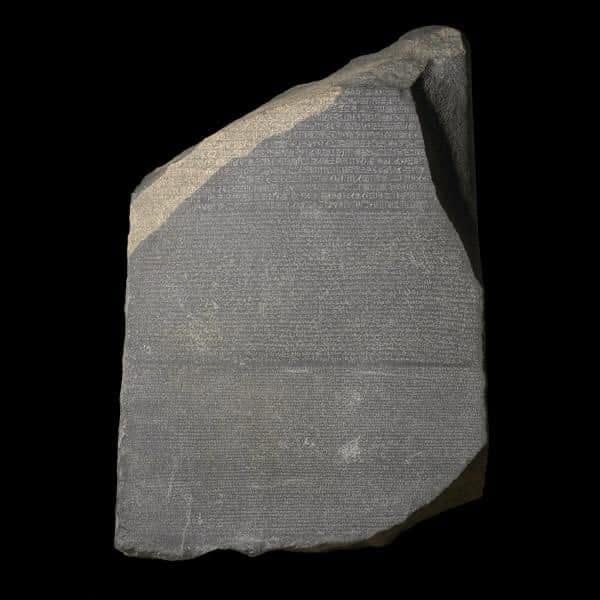
I couldn’t even get close to the Rosetta Stone. It was as popular and as crowded as the Mona Lisa is at the Louvre, so I had to borrow this picture from the British Museum’s website. The Rosetta Stone is said to date from approximately 332 BC, during the period when Alexander the Great conquered ancient Egypt. It’s called the Rosetta Stone because it was found in the Egyptian town of Rosetta (el-Rashid in Arabic) in 1799. The text contains three separate scripts: Classical Greek, a written version of Egyptian called demotic, and Egyptian hieroglyphs. At the time, scholars understood classical Greek and a little bit of demotic, so it became possible to translate the hieroglyphs. It took decades to decipher. At the time, hieroglyphs were thought to be pictorial versions of words, but scholars learned that many of them actually represented sounds, just as our alphabet does. By 1822, the French linguist Jean-Francois Cahmpollion had cracked the code.
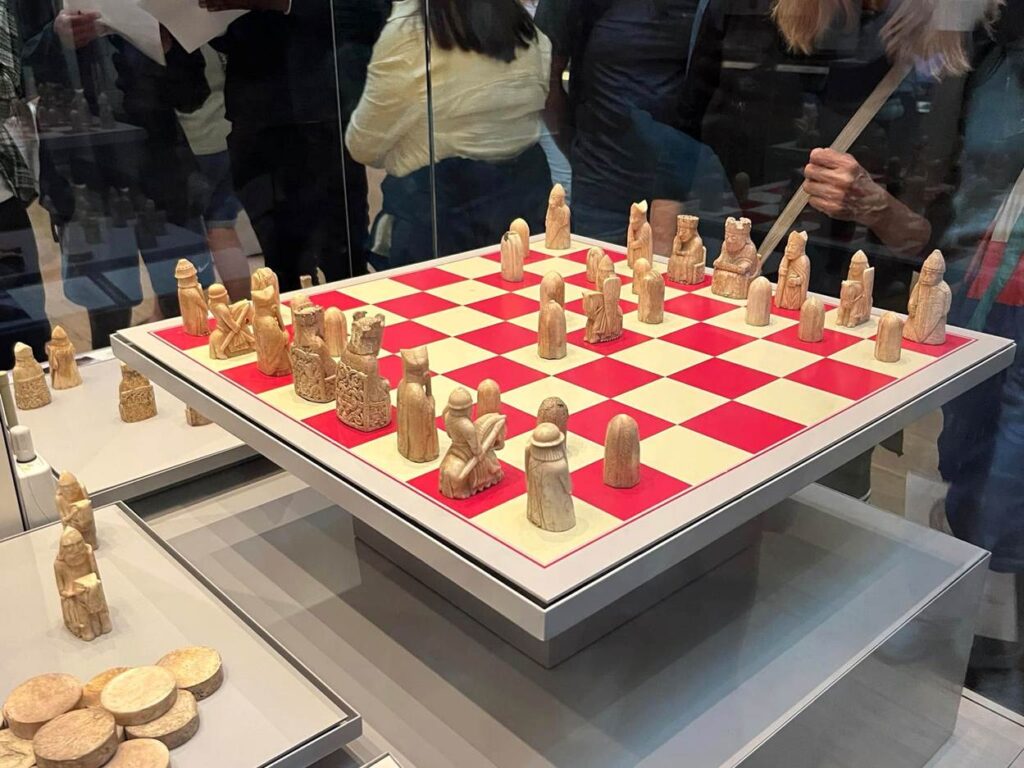
Chess allegedly originated around 500 AD in India and then spread to Europe through the Islamic presence in Spain and Italy. During the medieval period, it was used to sharpen the tactical abilities of knights. The Church forbade members of the clergy from playing chess, although they had relaxed this view by the year 1200. Men and women played chess together, so it became associated with flirtation and the battle of the sexes in medieval love poetry. In this set, one of the groups was originally red but most of the pigmentation has faded. These Lewis chessmen are 12th century pieces mostly carved of walrus ivory.
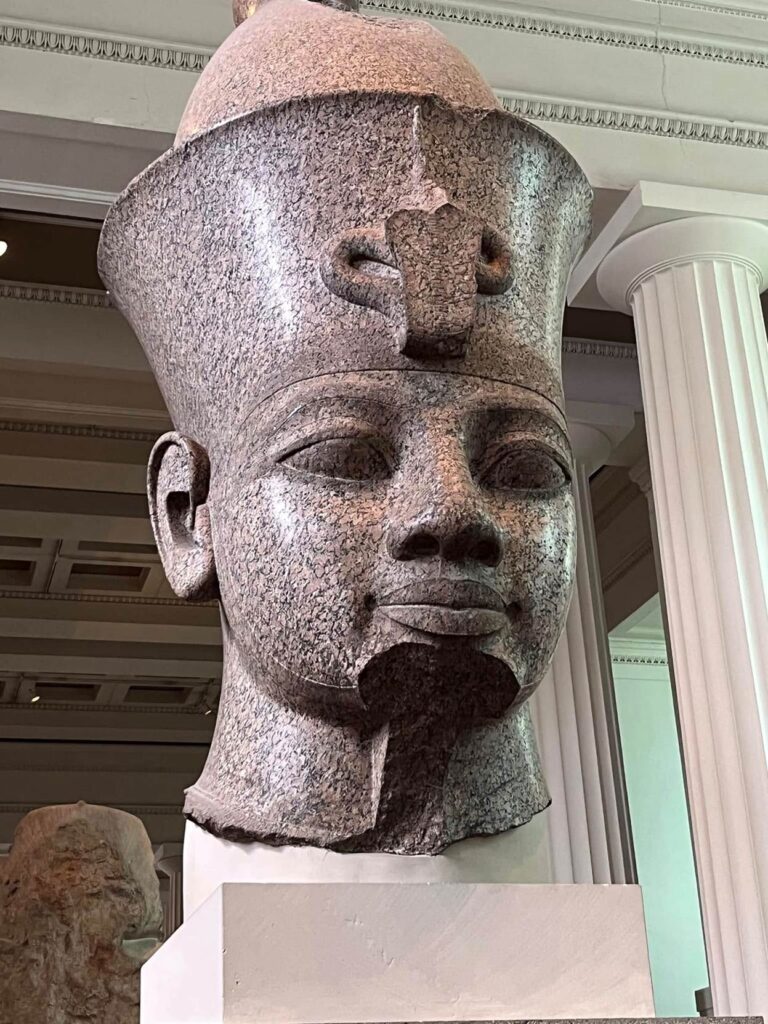
This statue portrays the head of Amenhotep III. He flanked a doorway in the temple of Karnak. Amenhotep’s peaceful reign was considered a time of opulence and artistic refinement, “often displayed on a grand and ambitious scale.”. This is one of several grand sculptures at the British Museum that features Amenhotep.
A century later, Ramesses II had the facial features reworked to resemble himself. Ramesses did this on countless statues of predecessors.
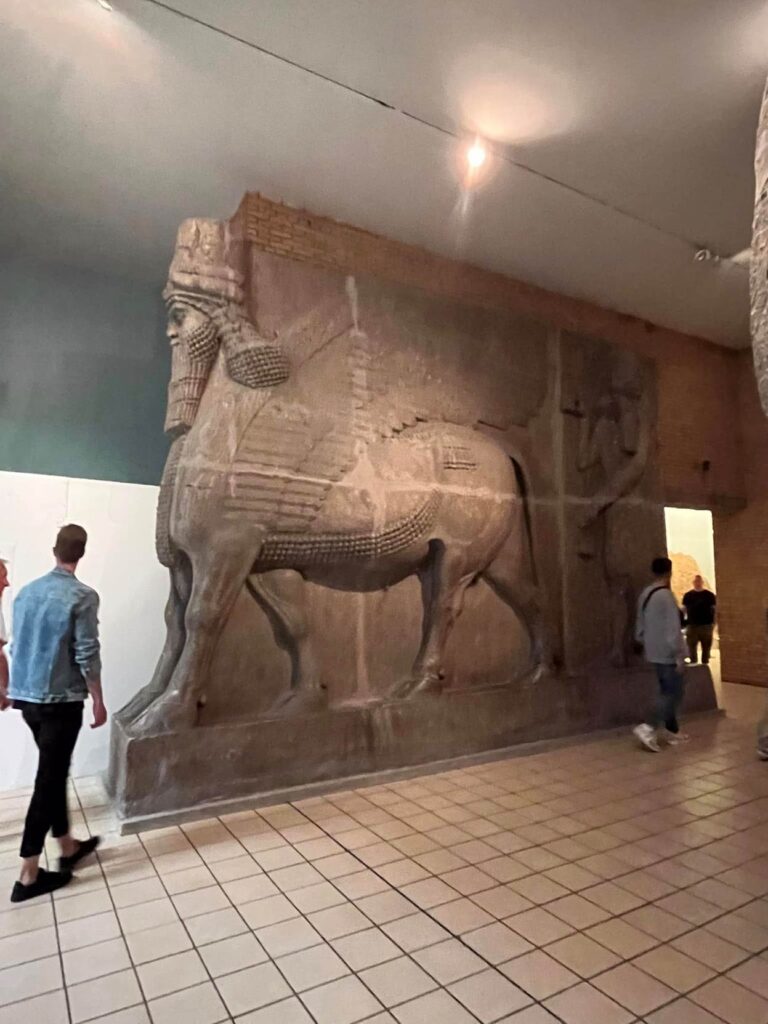
I left the people in this photo to give a sense of scale of these Assyrian human-headed winged bulls. They come from the city and palace of Khorsabad, built for the Assyrian King Sargon II, who reigned from 721-705 BC. The British Museum has a pair of these; they originally stood at one of the gates of the citadel as magic guardians against misfortune. Note that the bull has 5 legs. The statue was probably expected to be seen from either the front or the side, but not from an angle
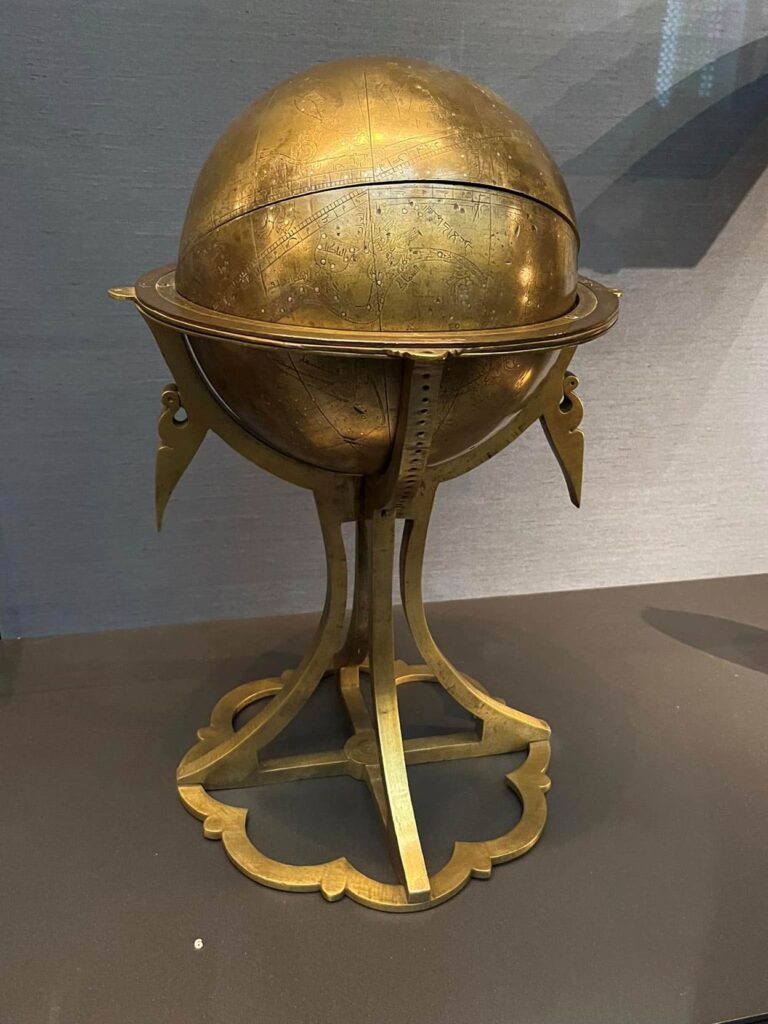
This astrolabe was made for the Iranian ruler Shah Sultan Husayn, who ruled from 1694-1722. According to the British Museum, “the leafy design of the star pointers may refer to the gardens of paradise, linking the skies to heaven itself.”. This was part of Sir Hans Sloane’s founding collection and was one of the first Islamic objects in the museum
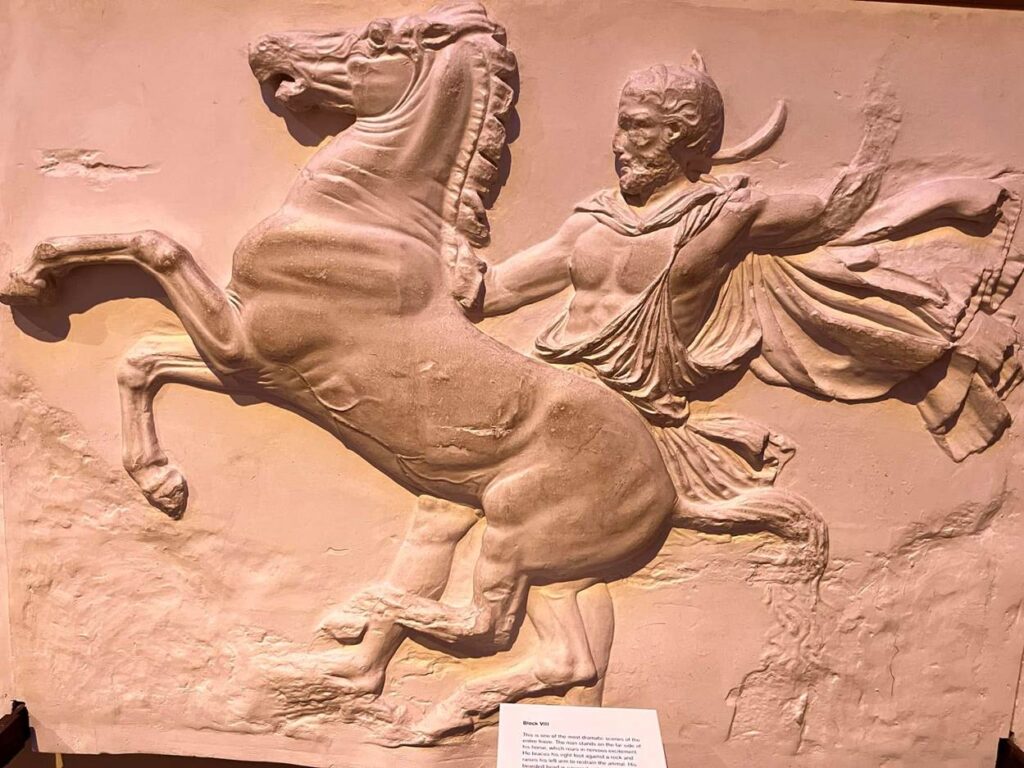
This is one of the infamous Elgin marbles, which came from the Parthenon in Greece and has been housed in the British Museum ever since. More on that in the next photo. In this scene, a man stands on the right side of his horse, who is rearing with nervous excitement. The man is wearing an animal-skin cap. You can see the tail flying out behind him. His cloak billows out behind him.
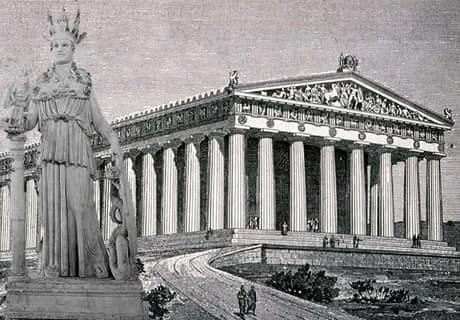
The Elgin marbles were once part of the frieze around the top of the Parthenon on the Acropolis. In the early 19th century, Greece was under the occupation of the Ottoman Empire, and Lord Elgin was an ambassador to the Sultan in Istanbul. Lord Elgin had the friezes chiseled off the temple and brought back to England from Athens between 1801 and 1805. The British Crown then purchased the marbles from Lord Elgin in 1816. Although this practice would definitely be forbidden today, it was common enough at the time. Lord Elgin claimed that he removed the marbles with the permission of the Ottoman officials who were in charge of Athens at that time, but this has been disputed. The marbles were created in the 5th century BC and depict battles between the Lapiths and centaurs. The fight erupted at the wedding feast of Pirithous, king of the Lapiths, when the centaurs became drunk and tried to carry off the women, including the bride. It is said that the subject later came to symbolize the human struggle between bestial inclinations and civilized behavior.
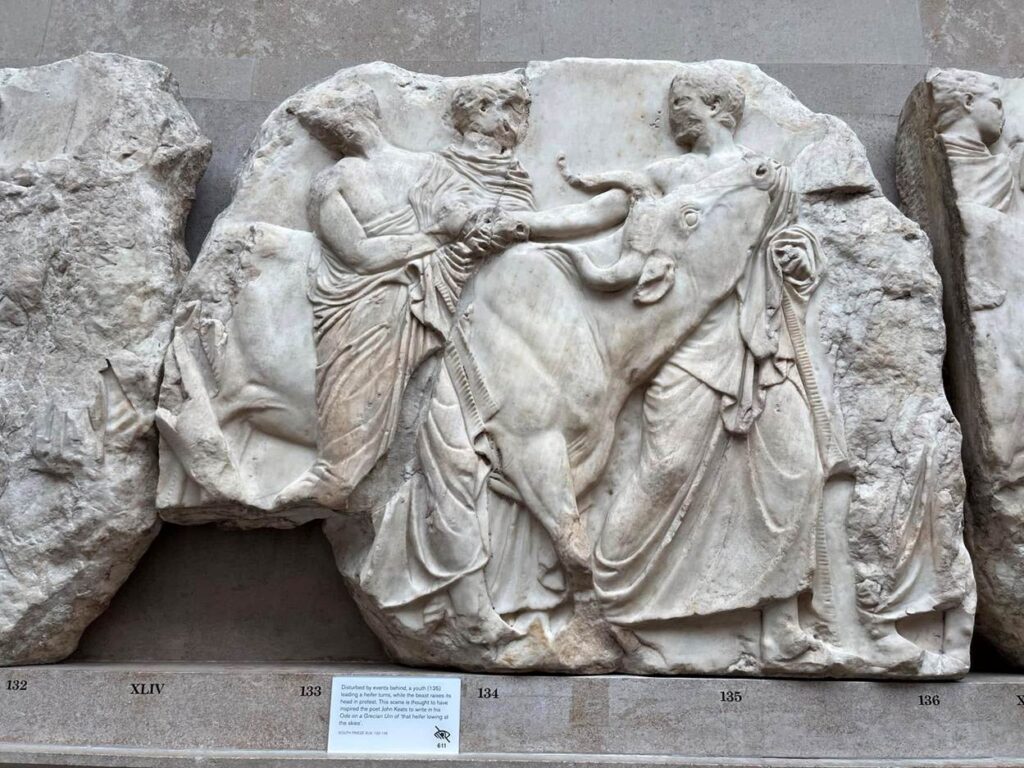
In another of the elgin marbles, a youth who is leading a heifer turns while the beast riases its head in protest. This scene is thought to have inspired poet John Keats’ line in “Ode on a Grecian Urn”: that heifer lowing at the skies.”
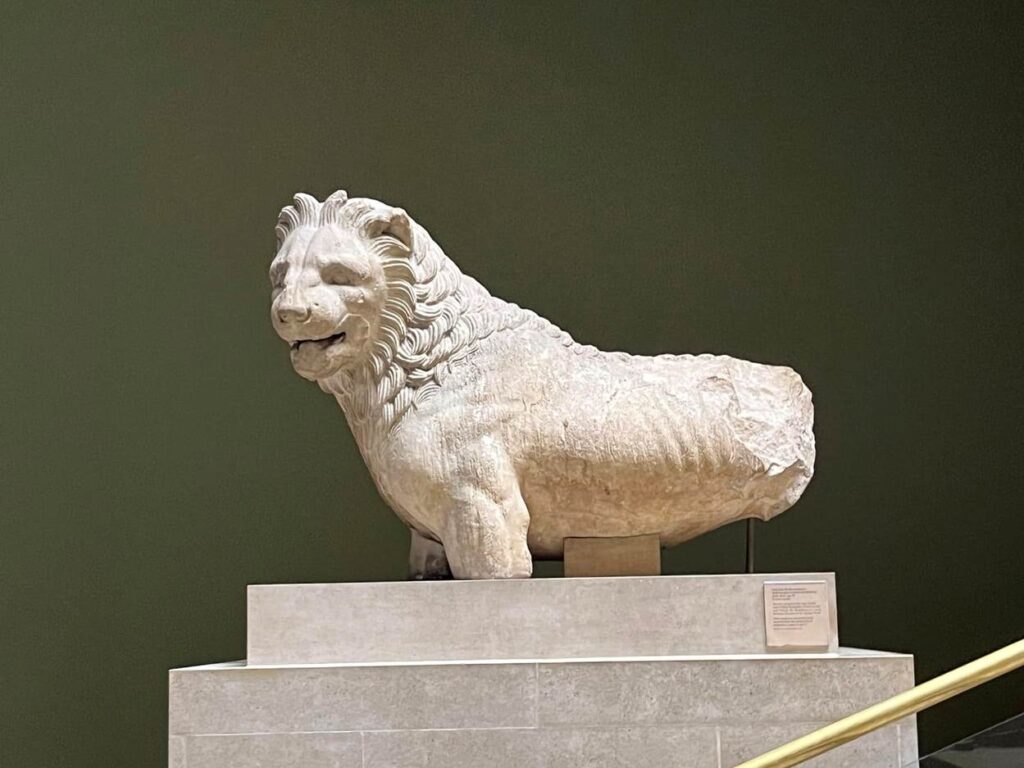
This lion was part of the large marble tomb of King Maussollos of Karia, in what is now southwest Turkey. I’ve included this one because the Mausoleum was one of the Seven Wonders of the Ancient World. It’s made of marble and was probably carved around 350 BC.
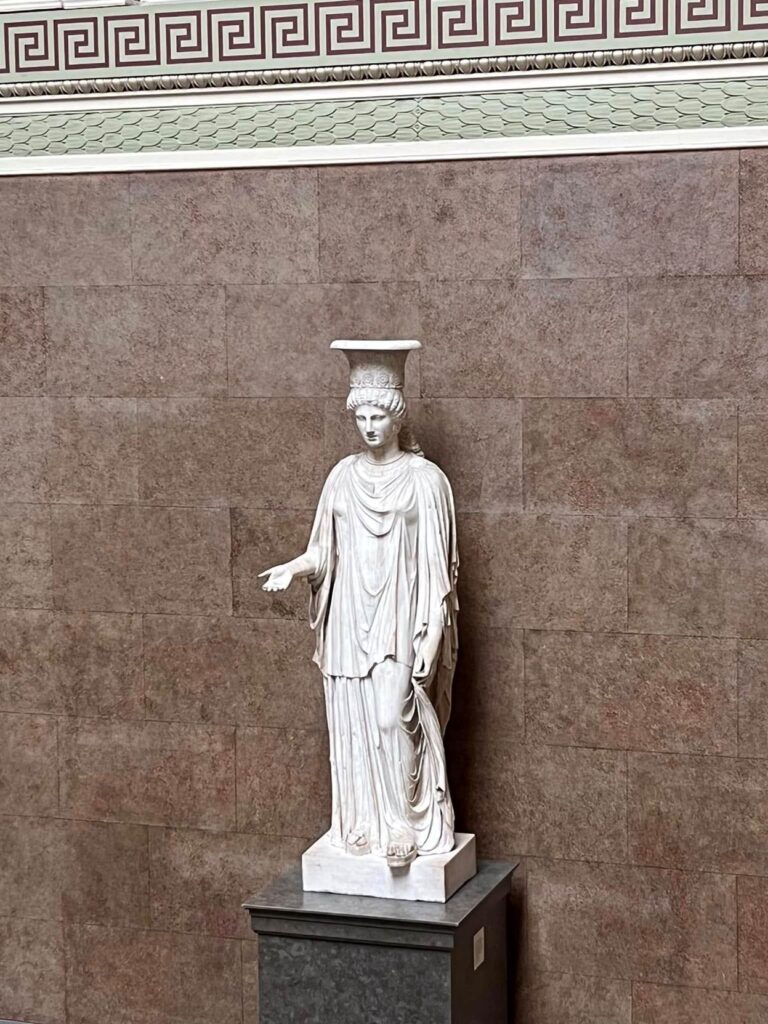
I originally thought this caryatid was from the Parthenon, but she’s actually from the Via Appia outside of Rome. Caryatids are female figures that serve as columns supporting a building. She’s Roman and dates from approximately 140-170 AD.
The British Museum is located on Great Russell Street in London, just steps away from the Tottenham Court Road tube stop. Admission is free. It’s open daily (except for December 24-26). The hours are from 10:00am to 5:00pm Saturday – Thursday and on Fridays from 10:00am to 8:30pm.