

Several people have asked me how (or if) Belgium (or Europe) celebrate Halloween.
Well, to answer that question, let’s go back to Halloween’s roots, which lead back 2,000 years to the ancient pre-Christian Celtic festival of Samhain. They believed that the boundary between the living and the dead thins between October 31st and November 1st. People would light bonfires and wear masks and costumes made of animal skins to confuse and ward off roaming ghosts. The Irish carved faces into beets and turnips to scare away spirits. Samhain was primarily observed in Ireland and Scotland. Around the 7th century, the Catholic Church wanted to discourage pagan traditions, so they designated November 1st as All Saints’ Day (AKA All Hallows’ Day) to honor martyrs and saints. Thus, October 1st became known as All Hallows’ Eve, which inevitably got shortened to Halloween.
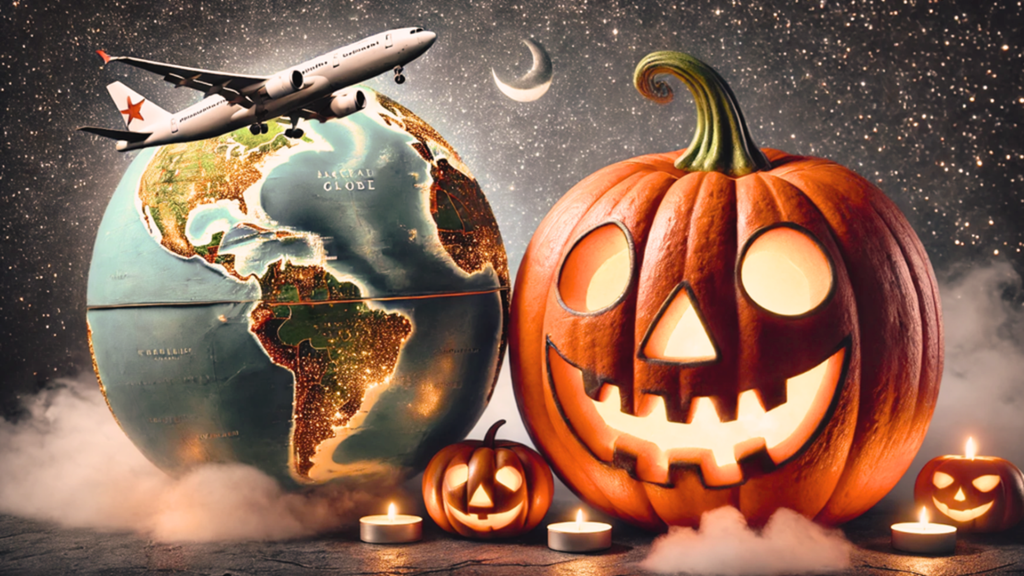
When the Irish emigrated en masse to the United States during the Potato Famine of the 1840s, they brought their traditions with them. They switched from turnips and beets to pumpkins. During the last half of the 19th century, Halloween became known as a day of ghost stories and neighborhood pranks. Unfortunately, the evening turned destructive, plaguing American cities with vandalism, rioting, and property damage. To counteract this, cities and schools in the 1920s organized parades and house-to-house costume events to shift the focus from rowdy teenagers to little children. This was the origin of the famous “trick or treat” – homeowners were encouraged to give small sweets or fruit to children as a sort of bribe so they wouldn’t be vandalized.
During the Baby Boom years of the 1950s, the big candy companies were happy to cash in on the phenomenon, offering small individually-wrapped versions of their trademark candies.
Halloween was not (and largely still isn’t) a typical holiday in Europe. The emphasis is on All Saints’ Day. However, Hollywood in the 1980s and 1990s exported visions of American Halloween through its multitude of Halloween-themed movies and TV specials, so Europeans became familiar with the American holiday. European businesses saw an opportunity to generate some late-October sales to tide them over between back-to-school sales in September and the Christmas sales of December. In addition, bars and nightclubs saw Halloween parties as a great opportunity for group gatherings and boosted beverage sales. Halloween had jumped the pond back to Europe.
Today, Halloween in continental Europe is celebrated in two main ways:
- For adults, it can be an excuse for raves and wild parties (especially for the young adult/college crowd), with participants in costumes. European costumes tend to trend towards scary, Gothic, and/or sexy. Think vampires, ghosts, and witches rather than Marvel superheroes, pop culture favorites, or funny concepts.
- Children are likely to experience community-organized events, such as pumpkin carving, pumpkin races, or trick or treating in a public plaza. Going house to house for trick-or-treating isn’t common here. Kids tend to dress up in what Rachelle calls “closet costumes”: homemade costumes created out of what Mom and Dad have on hand at home rather than purchased commercial costumes. Children’s costumes are usually iconic Halloween themes like skeletons and ghosts, or Disney characters.
What’s definitely different here in continental Europe as compared to the United States is that crazy over-the-top home and yard Halloween decor is definitely not a thing. I recently saw a video about how Americans decorate for Halloween vs how Germans do it. The German woman put a pumpkin on her front porch and called it good. The other main difference, as I mentioned earlier, is that trick-or-treating house to house isn’t done, and the candy isn’t nearly as sugary. Halloween tends to get conflated with the Mexican Dia de Los Muertos celebration as well as All Saints’ Day.
There is some pushback against the American version of Halloween, especially in religious regions that prefer to keep All Saints’ Day as a time to honor saints and honor deceased family members at cemeteries.
I’ve mentioned continental Europe several times here because Ireland and the UK have adopted some of the American traditions more eagerly. I’m less familiar with what they’re doing in the UK and Ireland, except to note that a holiday with pagan roots in Samhain has come back home to where it all began.
By Stephanie Larsen and Rachelle Martinez