

I still remember my first visit to the La Brea Tar Pits back in the early 1960s. I went with my 1st grade class and we descended into an observation area where we could watch the scientists dig out the bones of sabre-toothed tigers and Columbian mammoths. It smelled of asphalt (naturally). The adjacent museum didn’t exist yet, nor did the mammoth statues. As far as I recall, the ugly protective fencing didn’t exist on that long-ago day, but a lot has changed since then.
Visitors today can only look at the tar pits from outside the protective fencing (although officials warn folks that there is tar seepage throughout Hancock Park, so you still need to be a bit cautious). You’ll see the sad Columbian mammoth family helplessly calling to the stuck mama mammoth.
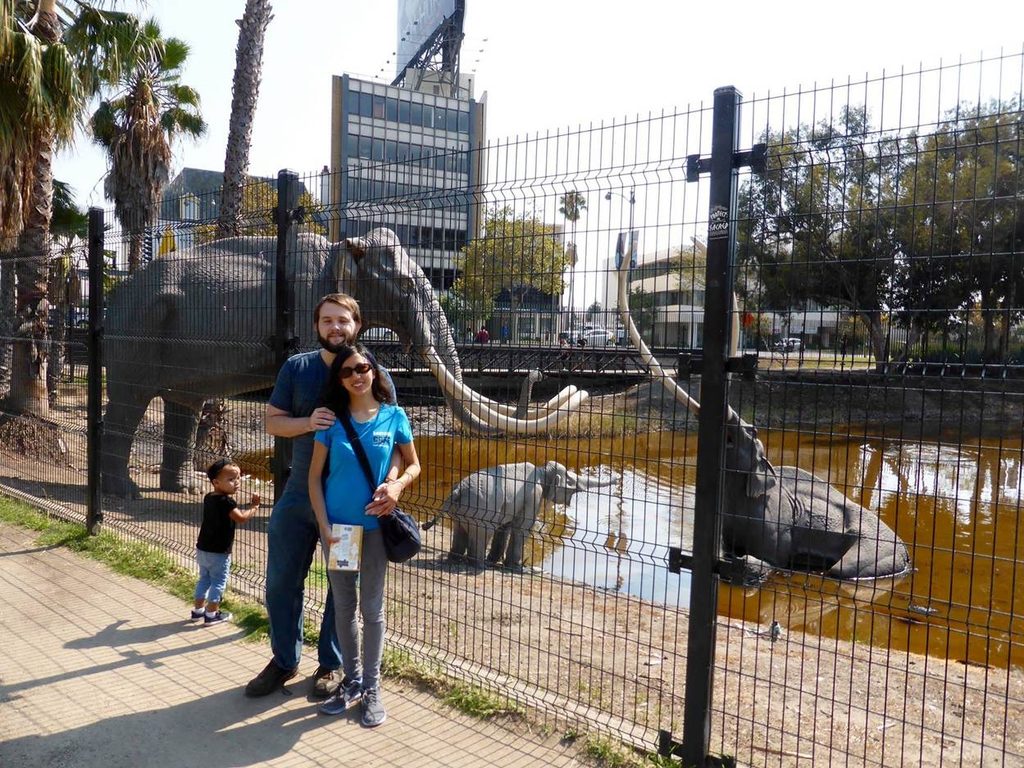
The La Brea Tar Pits are formed by naturally occurring asphalt that bubbles up from beneath the earth’s surface. Methane gas causes the bubbles you see. Large herbivores (plus lots of other species) from the Late Pleistocene Epoch (Los Angeles’ last Ice Age) would wander into the area and find themselves trapped. Then, carnivores looking for an easy meal would try to jump in to obtain some fresh meat – and they would get trapped, too. Thus, the La Brea Tar Pits have yielded fossils of Columbian mammoths, mastodons, sabre-toothed cats, now-extinct species of lions, camels, and horses, dire wolves, and much, much more. The fossils date from 10,000 – 38,000 years ago. Sadly, they also tell us that the magnificent mammoths went extinct around 13,000 years ago due to rapid climate change.
The first human mention of the Tar Pits occurred in 1769 in a diary entry by Juan Crespi. Crespi was a Franciscan friar accompanying the expedition of Gaspar de Portola, who served as the first Spanish governor of California. Crespi’s diary referred simply to “springs of pitch”.
The Spaniards must have recognized its value. In 1828, a Mexican land grant of 4,400 acres was made to Antonio Jose Rocha. This Rancho La Brea grant stipulated that residents should have access to as much asphalt as they wanted. Note that the very name of the rancho, La Brea, translates as “the tar”. La Brea’s asphalt was prized as a roofing material.
The bones in the tar pits were originally thought to be those of domestic animals or other local animals. It wasn’t until 1901 that the bones were recognized as being from long-extinct species. Geologist W.W. Orcutt discovered a rich fossil deposit in 1905. He contacted UC Berkeley, and the rush to acquire fossils from the La Brea Tar Pits began. People and institutions came from all over the world to obtain specimens.
By this time, George Allan Hancock was the last owner of Rancho La Brea. In 1913, he gave Los Angeles County exclusive rights to excavate for a two-year period so the bones would stay in the community. Thus, the best-documented collections were made by the Los Angeles Museum between 1913 and 1915. One of those major fossil deposits, Pit 91, is still being excavated today.
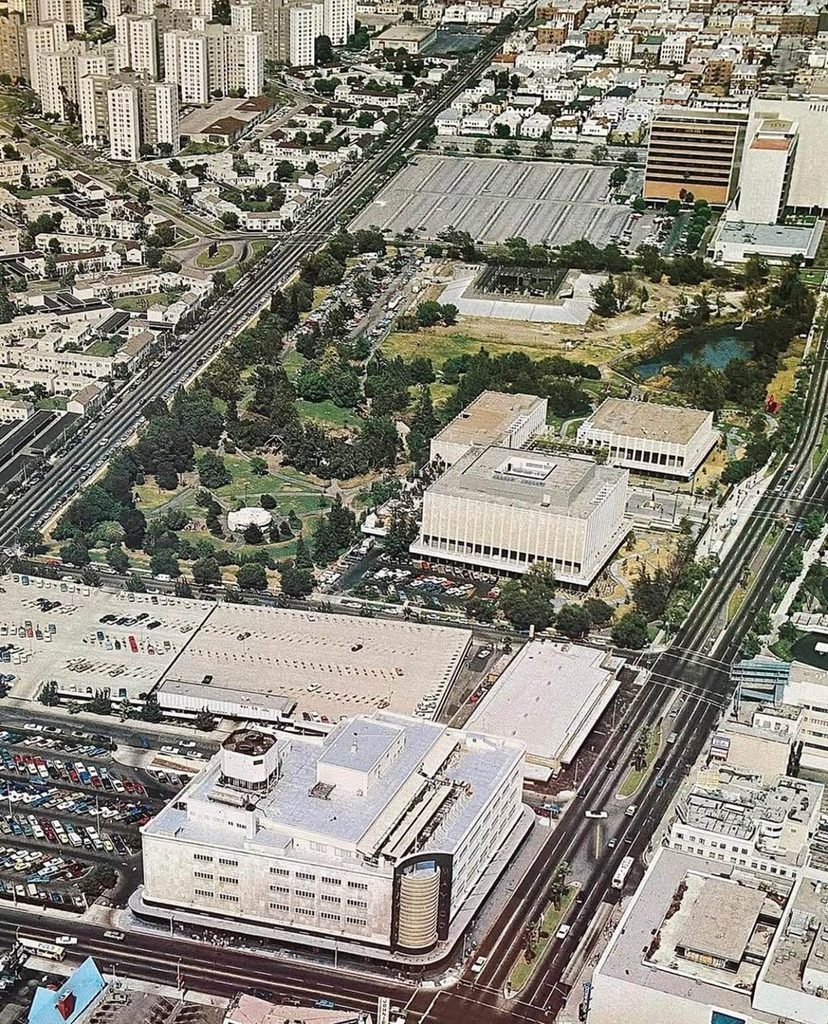
1976 photo of the Tar Pits and surrounding area, courtesy of Classic Los Angeles. The tar pits are that dark lake surrounded by trees on the upper right, and the Page Museum is the three-sided rectangle to the left of the Tar Pits (it didn’t open to the public until 1977 but it looks like construction is finished or nearly so in this photo). You can also see the parking lot for the Tar Pits just above the Page Museum. The buildings associated with the Los Angeles County Museum of Art (better known as LACMA) are in the center. The historic May Company building (now the Academy Museum of Motion Pictures) is the large building on the bottom of the photo with the golden column on its right front corner.
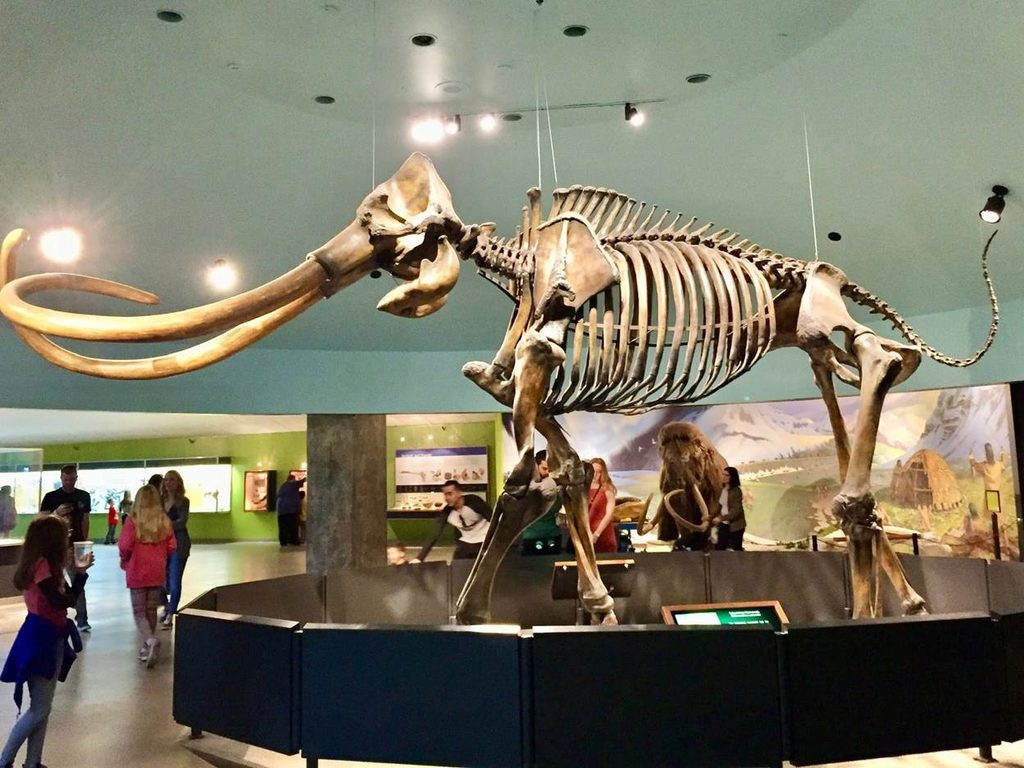
One of the largest skeletons retrieved from the Tar Pits, this Columbian Mammoth is the pride of the Page Museum.
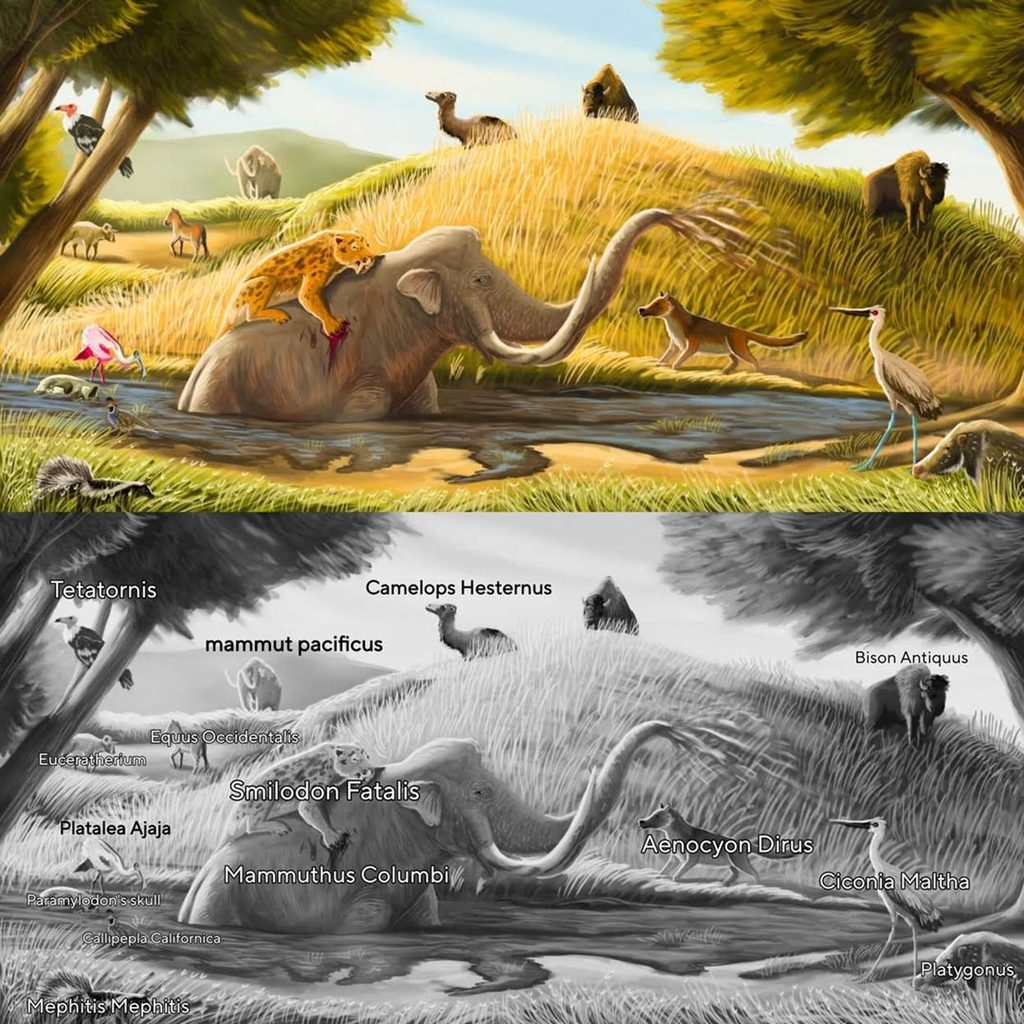
Diagram of some of the Pleistocene-era animals found in the Tar Pits, courtesy of The Paleo Page.
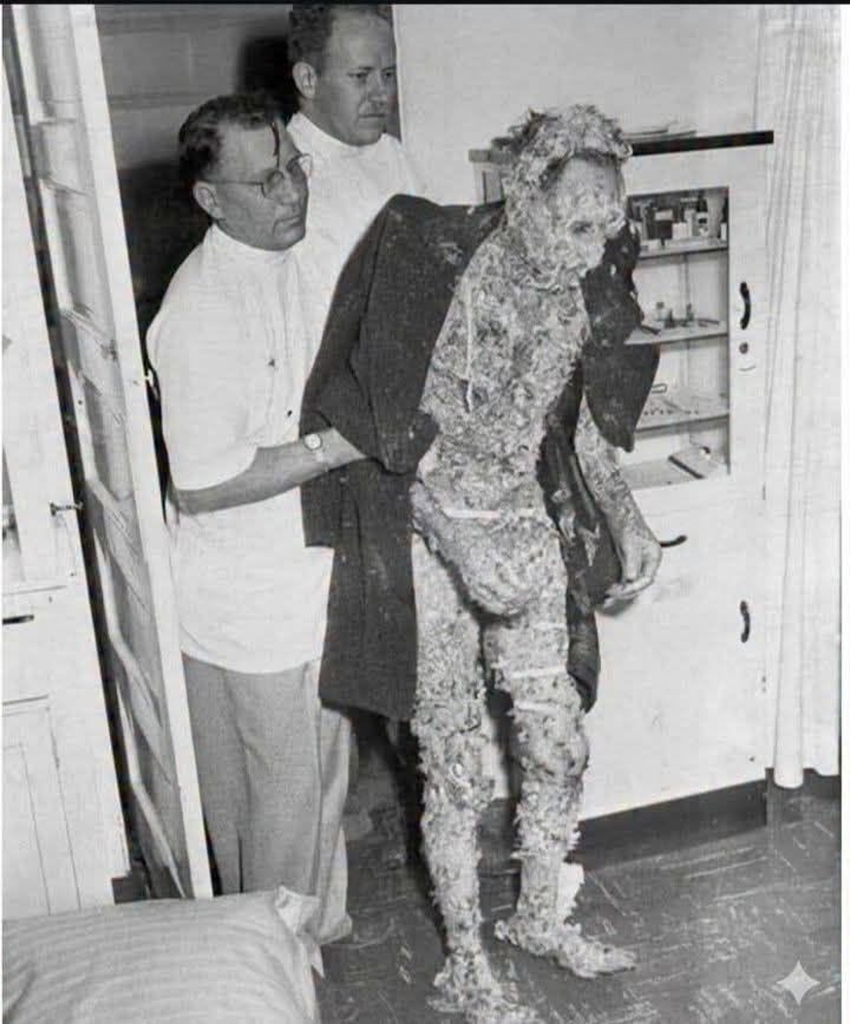
June 24, 1951. What began as an ordinary day ended with one of the most memorable rescue images in California’s emergency history. The photograph shows Grady Johnson, whose dog got into the tar pits. Without thinking, Johnson jumped in to save his dog. The tar pits are not hot. They don’t boil or smoke. They are a cold but deadly mixture of natural asphalt, oil, and clay. The surface looks solid enough to stand on, but that sticky mixture just below the thin crust tightens with every movement. It’s almost impossible to escape once entered. After Johnson jumped in, the asphalt immediately clung to his skin and clothes, hardening with every movement. Each step became heavier, each second more dangerous. What trapped prehistoric giants was now trapping a man — alive. Johnson and his dog were extremely fortunate. They were rescued and survived. The photo shows him entirely coated with asphalt from the tar pits. (Photo courtesy of Hidden History).
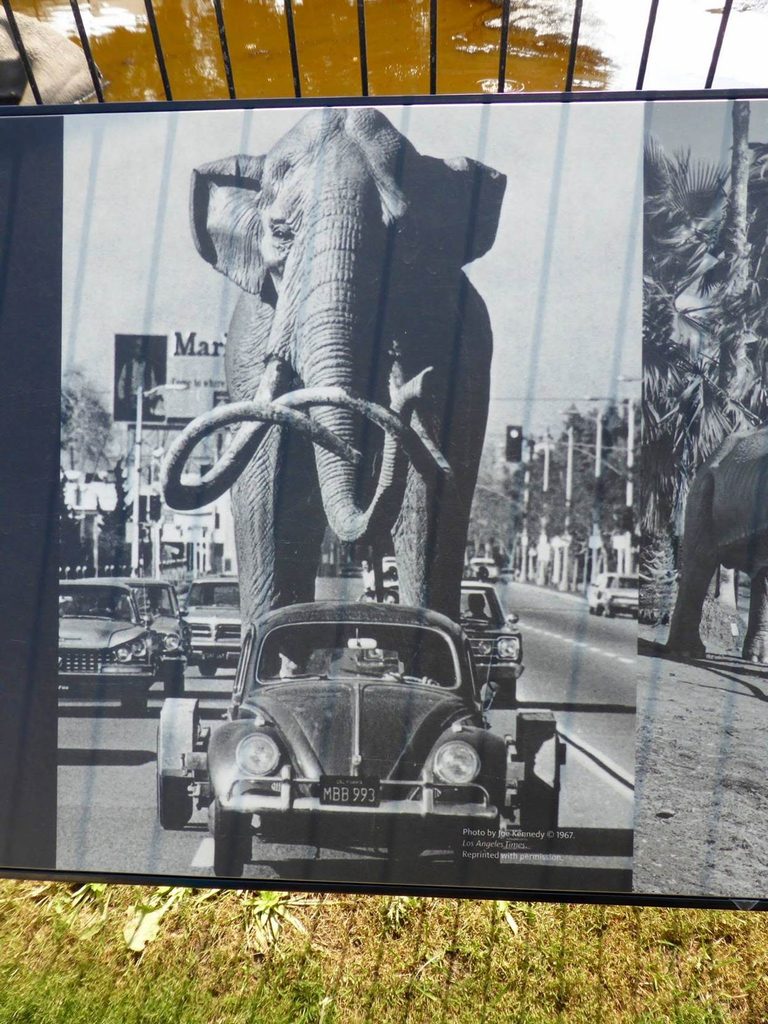
In January 1967, sculptor Howard Ball used his 1958 Volkswagen Beetle to tow his life-sized mammoth sculpture down Wilshire Boulevard for its installation at the Tar Pits.
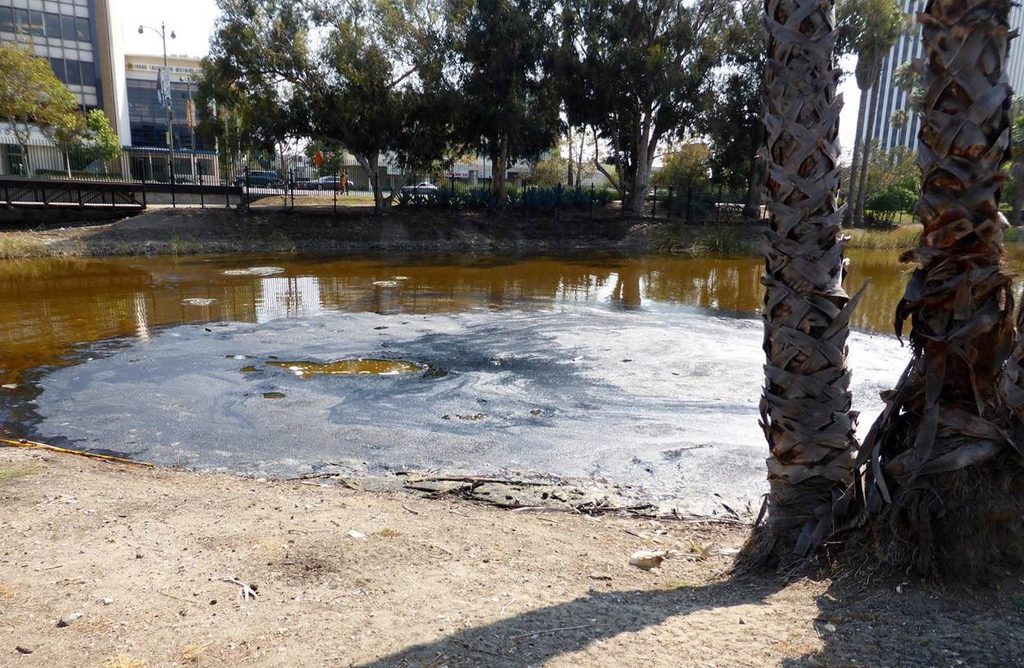
The Tar Pits boil and bubble. Well, actually, they DON’T boil. Their temperature is whatever the current outdoor temperature is. The bubbles are caused by methane and other gases rising up from deep below the surface.
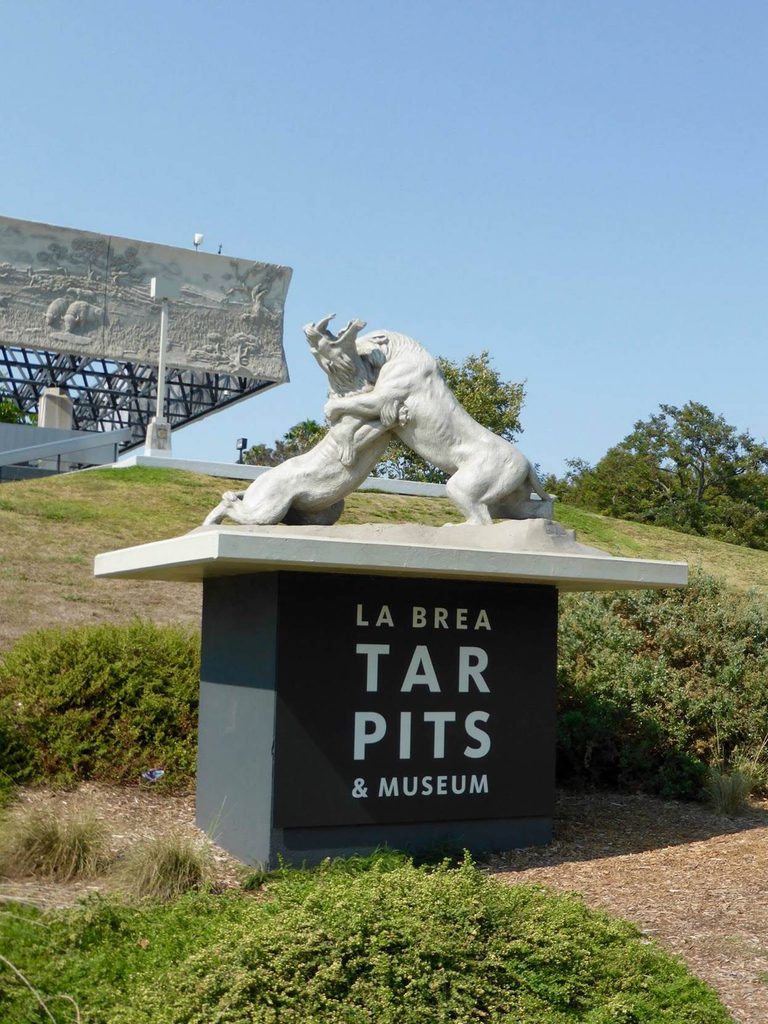
Two sabre-toothed cats fight near the entrance to the Page Museum. Note how muscular they are. You can see part of the museum’s façade on the upper left.
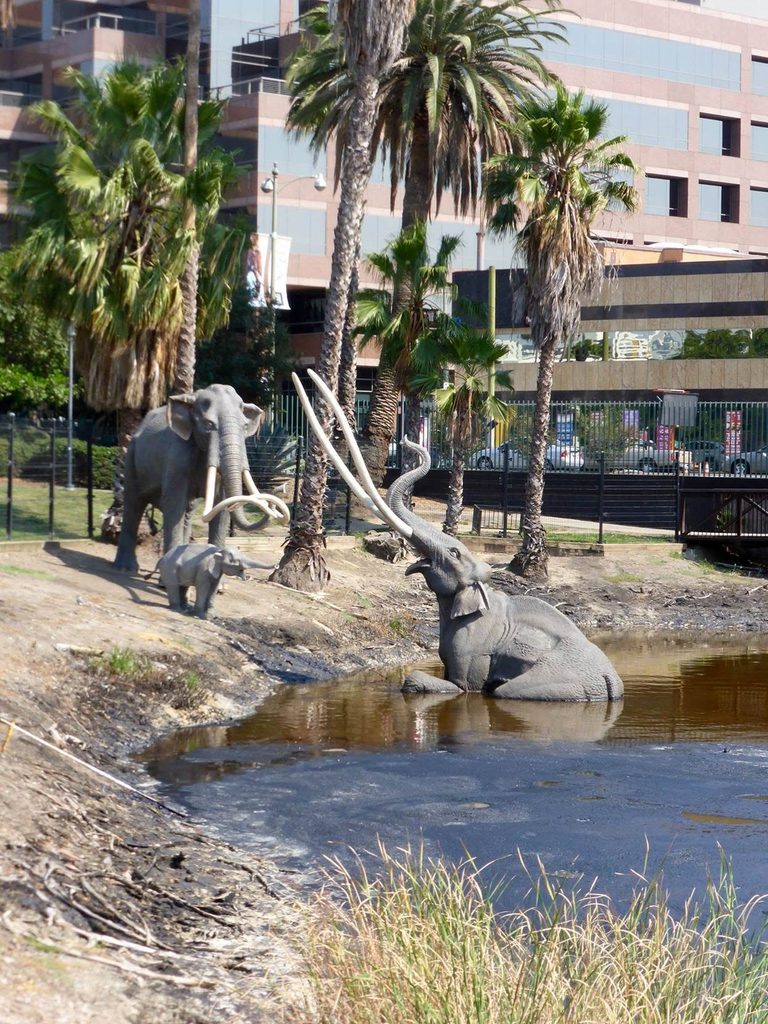
A better view of the Columbian mammoths stuck in the Tar Pits. I stuck my camera through the wire fence to take this picture.
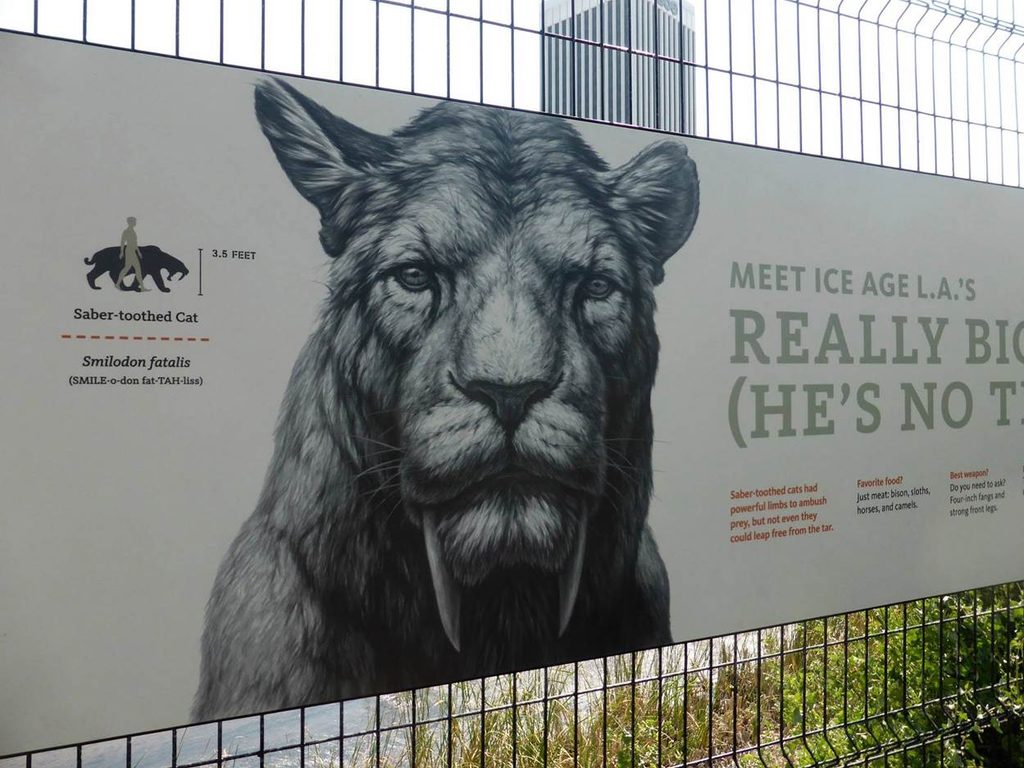
Wouldn’t it be magnificent if these beasts were still alive? Smilodon fatalis, AKA the sabre-toothed cat, was built short, stout, and muscular, with thick leg bones designed for wrestling heavy prey rather than running fast. In contrast, modern tigers are longer and more agile, built for stalking and running.
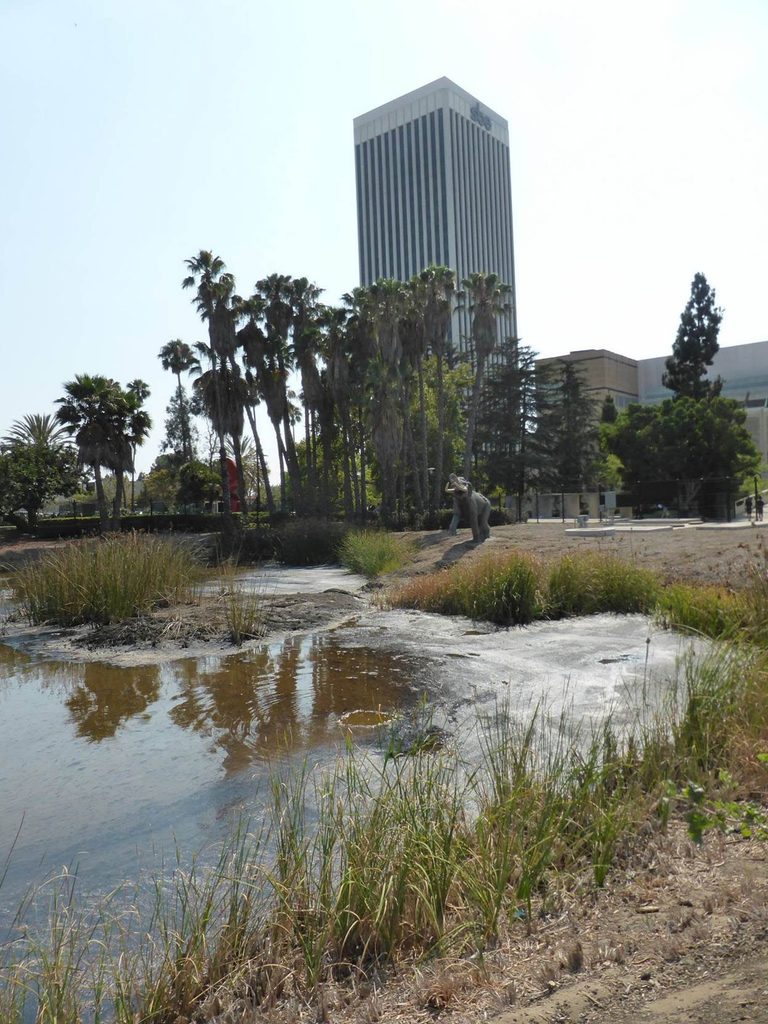
Modern Los Angeles surrounds the ancient La Brea Tar Pits.
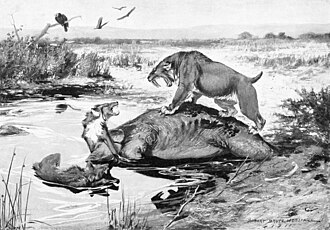
A diagram from the Page Museum.
The La Brea Tar Pits are located at 5801 Wilshire Boulevard in Los Angeles, next to the Los Angeles County Museum of Art and the Academy Museum of Motion Pictures – so you can make an entire day out of this one location.
The Page Museum (now the Museum at La Brea Tar Pits) is currently closed “for a mammoth makeover”, but if you want to do more than peek at the mammoths through the wire fence, they do offer a Tar Pits Insider Tour, which lets you go behind the scenes with the scientists, sort through real fossils, get up close to the mammoth sculptures, and explore the bubbling tar pits up close. Unfortunately, that insider tour comes at a mammoth price: $125 for adults and $105 for children. If you’re up to shelling out that much green, they do the insider tours on Fridays at 11:00am and on Sundays at 11:00am and 2:30pm.
Since this is car-centric Los Angeles, there’s a dedicated parking lot located at 725 S. Curson Avenue. There’s also an underground parking garage which can be accessed from W. 6th Street. If you prefer public transportation, the Metro D Line (purple) stops at Wilshire Boulevard and Fairfax Avenue.