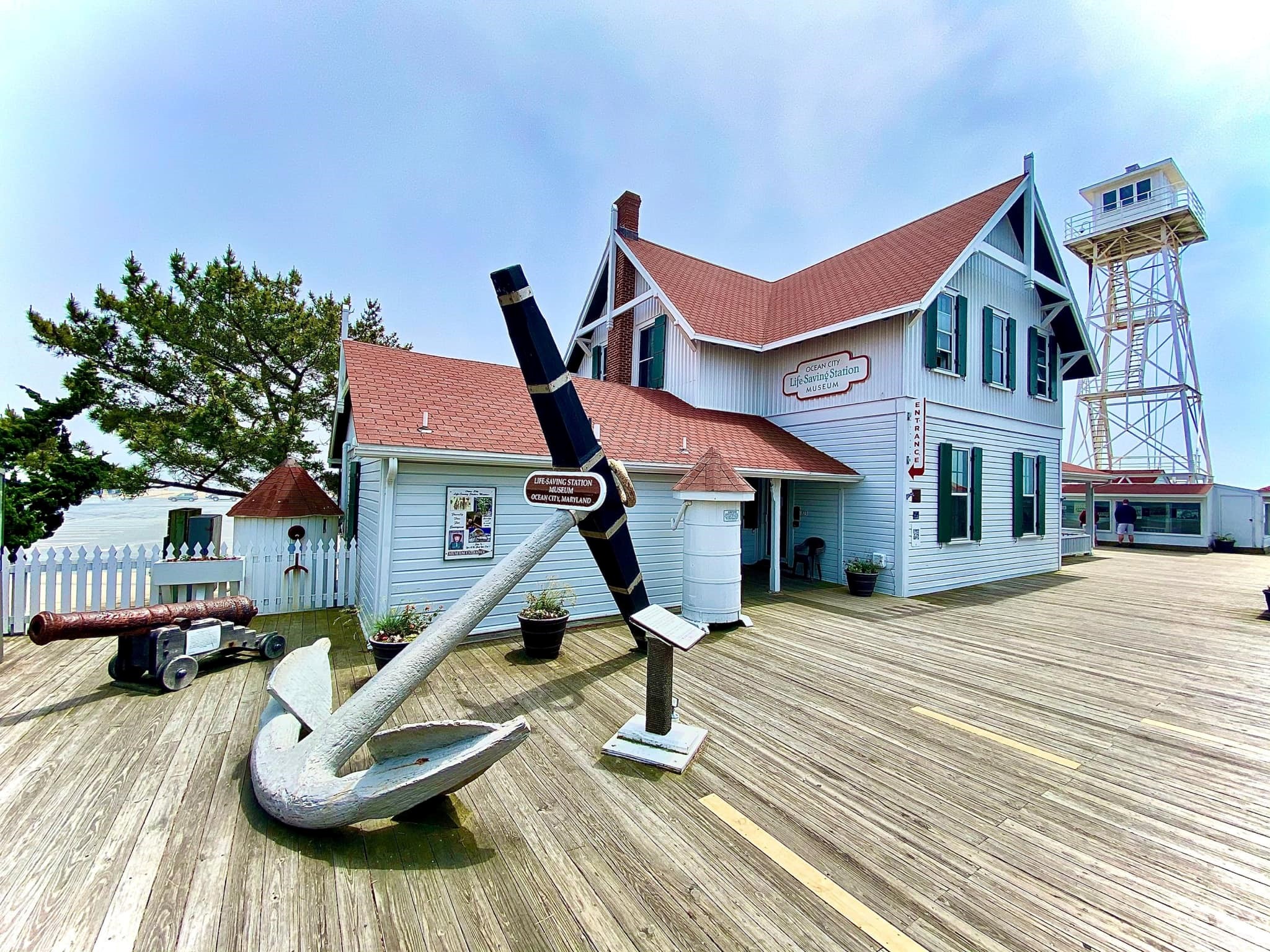
Figure 1The Ocean City Life Saving Station Museum (photo from the internet).
Ocean City’s Life Saving Museum (Maryland)
When I saw that Ocean City had a life saving museum, I thought it was about the lifeguards rescuing hapless swimmers out on the beach. But that wasn’t it, at all.
The US Life Saving Service began in 1879. Its purpose was to help people stranded by shipwrecks. In 1915, it would be merged with the Revenue Cutter Service to form the modern-day US Coast Guard.
Ocean City’s (and one of America’s) first Life Saving Station was created in 1878 as a lease agreement between the landowner, Stephen Taber and the US Treasury Department, which allowed the federal government to lease the land for $1 per year for 100 years. The Station was one of the first buildings erected in Ocean City. A second Station was built in 1891. The Life Saving Museum is housed in that second Station.
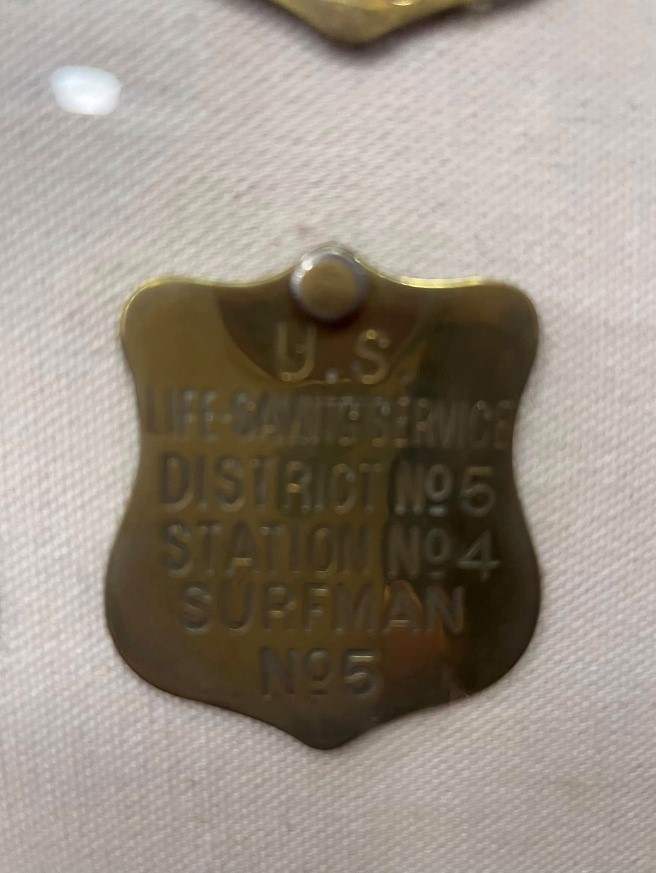
Stations were usually built five to ten miles apart with beach patrols conducted between the stations. The “surfmen”, as they were called, would meet about halfway between their station houses and exchange brass tags as proof that their patrol had been made.
Figure 2: Example of one of the brass tags exchanged by the surfmen during their patrols. It would have the number of the station and of the surf man on it.
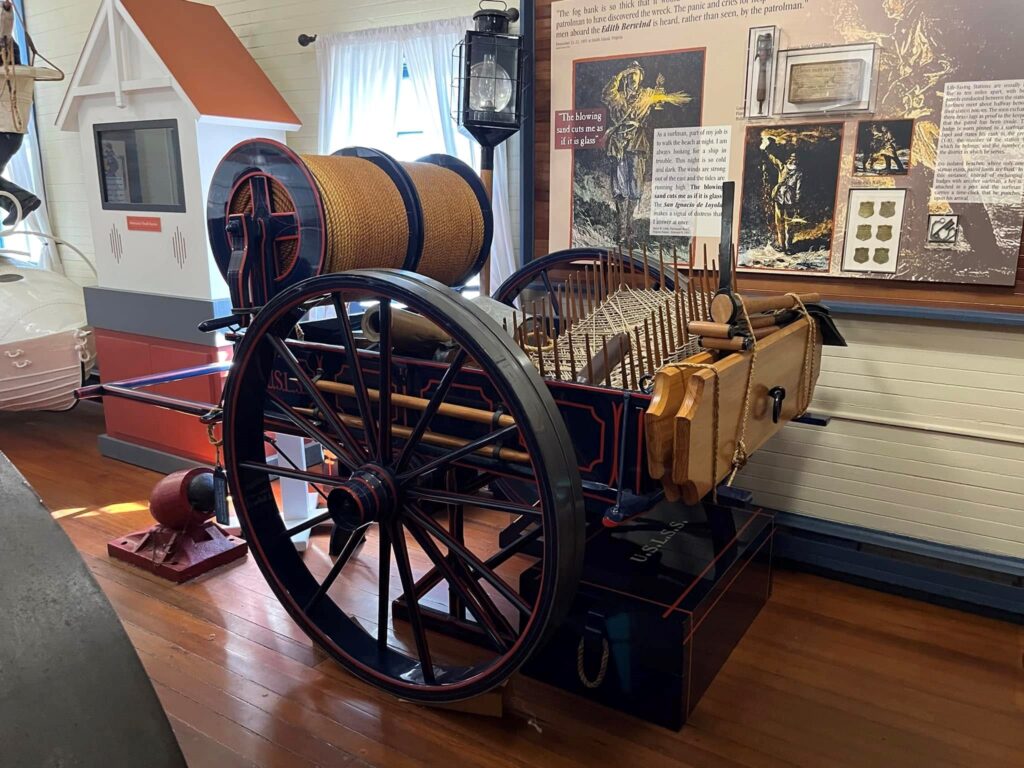
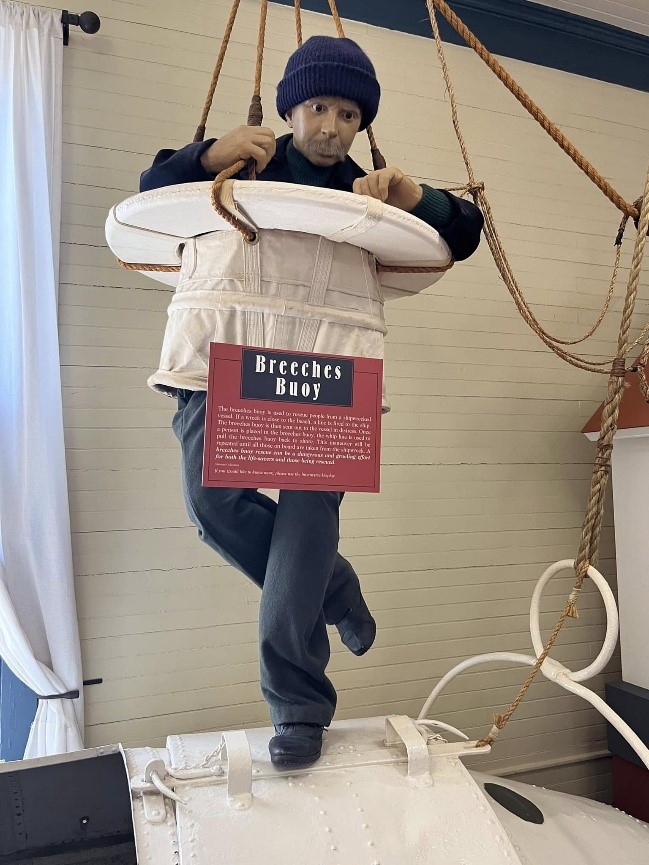
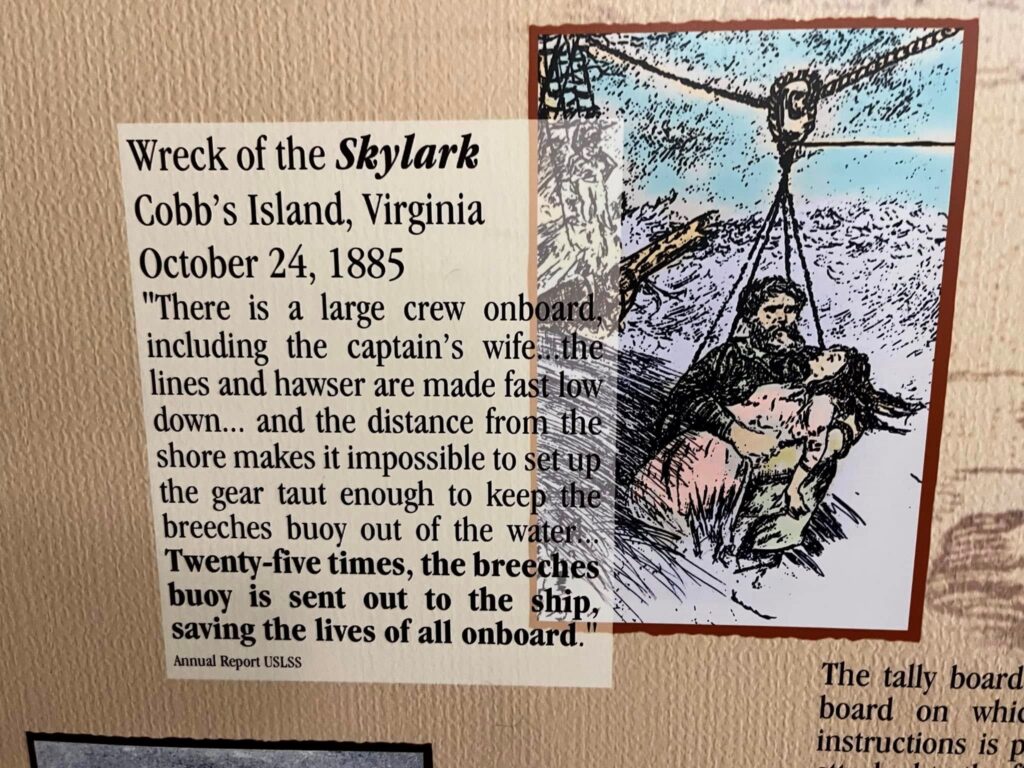
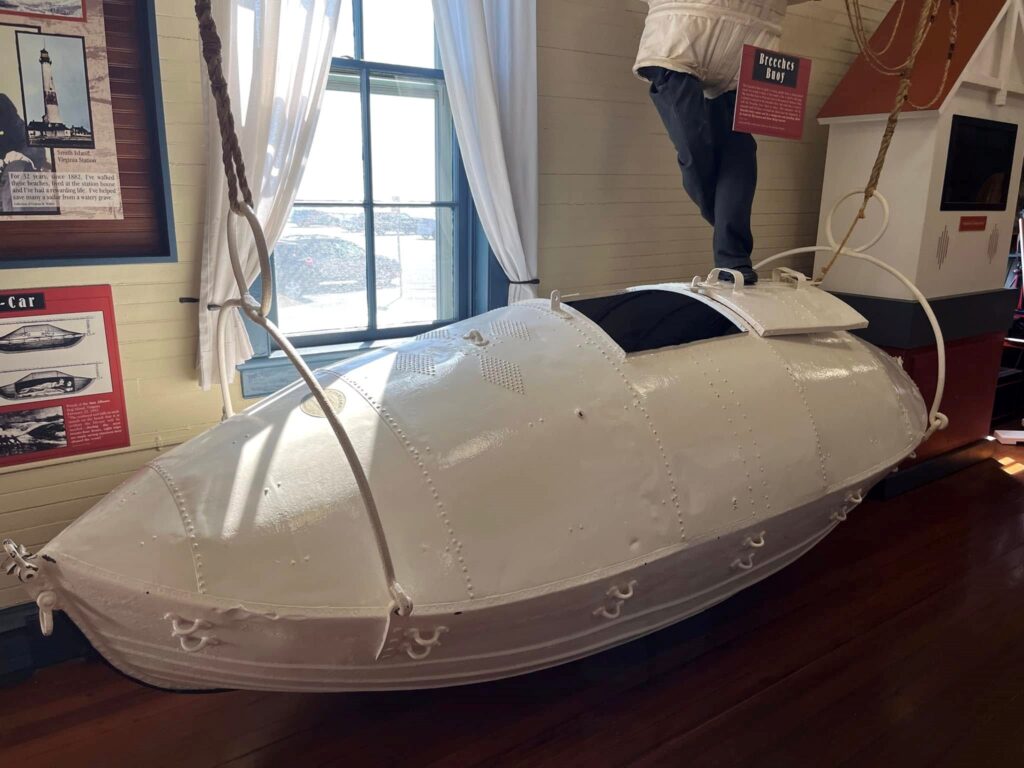
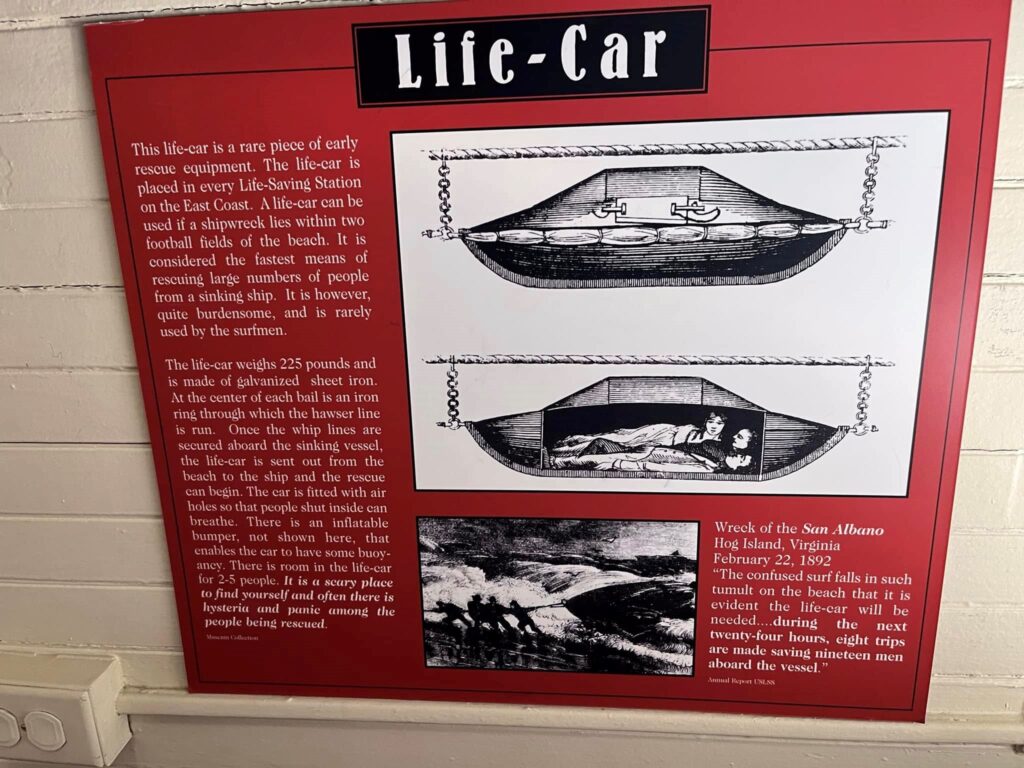
When a shipwreck was spotted and the crew notified, the life-savers would have to pull a heavy equipment cart to the site of the shipwreck. They used a Lyle gun to throw a rope to the ship (with accuracy to 300 yards). The gun alone weights 163 pounds. Once the line was established, the rescuers would send a breeches buoy out to the vessel, which would then be pulled back to the beach, rescuing one person at a time. The procedure would be repeated as often as necessary. It was hard work for the rescuers, and even worse in nasty weather (which, of course, is when many shipwrecks occurred). Occasionally, a life car would be used. It could hold 2-5 people and was used when a shipwreck was within 200 yards of the beach. The life car was used far less frequently than the breeches buoy because it was heavy (225 pounds) and cumbersome. It, too, needed to be sent out to the shipwreck via a whipline.
Figure 3This is one of the apparatus carts that the rescuers had to pull to the site of the shipwreck. It has wide wheels to trek over the sand. Fully loaded, it was over 1,000 pounds and it was grueling work to move it over the sand to the shipwreck site.
Figure 4: An example of a breeches buoy, the most commonly used method to rescue shipwreck victims.
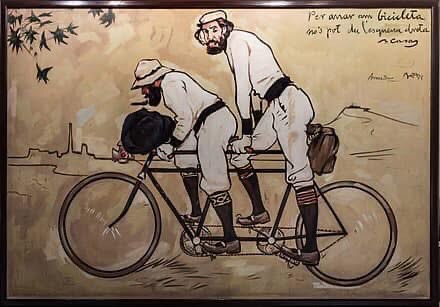
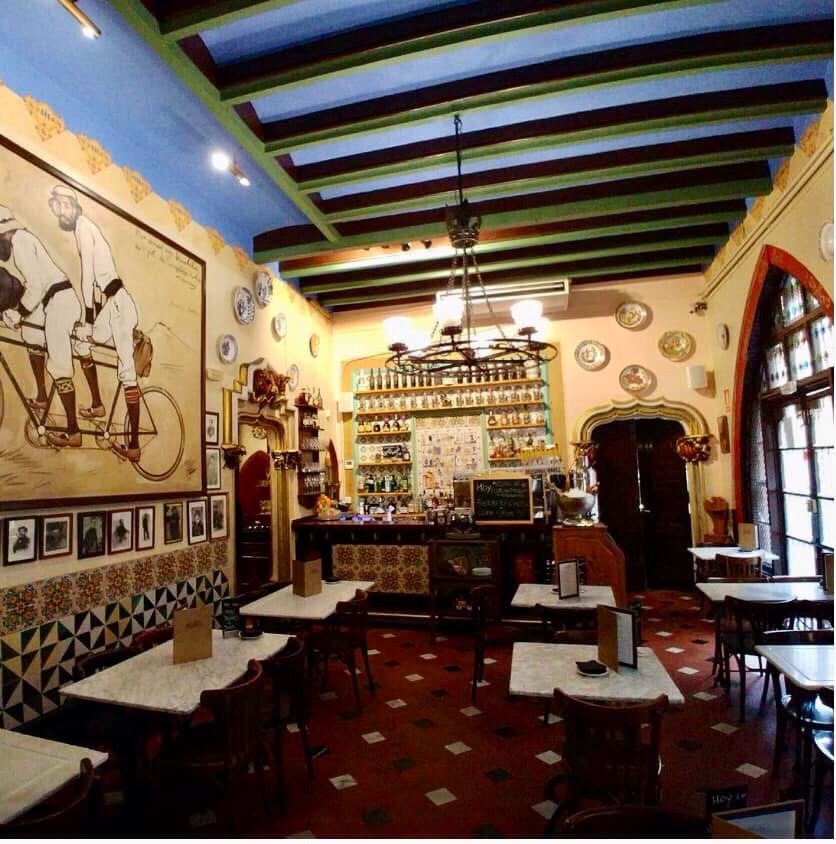
Ramon Casas painted a painting of himself and Romeu riding a tandem bicycle with a phrase in the upper right-hand corner: “to ride a bike, you can’t go with your back straight”.They saw it as a way of saying that cultural breakthroughs require moving beyond the norms.A copy of that painting is still on the walls of El Quatre Gats today (the original is in a museum).
Ramon Casas painted a painting of himself and Romeu riding a tandem bicycle with a phrase in the upper right-hand corner: “to ride a bike, you can’t go with your back straight”.They saw it as a way of saying that cultural breakthroughs require moving beyond the norms.A copy of that painting is still on the walls of El Quatre Gats today (the original is in a museum).
Romeu intended the cafe to serve more than mere food and drink.He wanted it to be a place for “food of the spirit”.He soon realized that dream as Els Quatre Gats became the favorite meeting place for the artsy/literary set of Modernisme-mad Barcelona.This included Antonin Gaudi, the architect responsible for Park Guell, the beginnings of the La Sagrada Familia basilica, and several other Modernisme-style residences in Barcelona.
A 17-year-old who was new to town also became attracted to the artsy ambience of Els Quatre Gats.His name was Pablo Picasso.He drank in the influence of the older artists around him.Perhaps he was inspired by the bicycle painting’s caption about breaking tradition.He held his very first art exhibition, about 100 paintings, in the main room of Els Quatre Gats.And, of course, he would later become VERY famous for breaking all known conventions in art.
Romeu intended the cafe to serve more than mere food and drink.He wanted it to be a place for “food of the spirit”.He soon realized that dream as Els Quatre Gats became the favorite meeting place for the artsy/literary set of Modernisme-mad Barcelona.This included Antonin Gaudi, the architect responsible for Park Guell, the beginnings of the La Sagrada Familia basilica, and several other Modernisme-style residences in Barcelona.
A 17-year-old who was new to town also became attracted to the artsy ambience of Els Quatre Gats.His name was Pablo Picasso.He drank in the influence of the older artists around him.Perhaps he was inspired by the bicycle painting’s caption about breaking tradition.He held his very first art exhibition, about 100 paintings, in the main room of Els Quatre Gats.And, of course, he would later become VERY famous for breaking all known conventions in art.
Figure 5An illustration of the breeches buoy, where you can see the whipline and cabling. In this case, it looks like a male rescuer came with a female rescuee.
Figure 6: The life car was sent out less often than the breeches buoy because of its weight, but it could hold 2-5 (sometimes hysterical) people. The noise of the pounding surf on the metal could be quite scary for the victims.
Figure 7: Diagram of the interior of a life car.
During its 36 years of existence, the 19 Life Saving Service stations on Maryland’s Eastern Shore would rescue 7,502 people from over 300 shipwrecks. Prior to the establishment of the Service, no help was available to the shipwrecked because the East Coast barrier islands were so sparsely populated.
March 9, 2025
Els Quatre Gats hosted art exhibitions, literary and musi evenings, poetry readings, and puppet shows.It was hugely popular.Unfortunately, Simon was perhaps better at art than running a business.He provided meals to friends at a discount, or gave them away.After six short years, Els Quatre Gats was forced to close in June 1903.
Casas and Utrillo kept its influence going with a literary magazine, but Els Quatre Gats as a cafe slumbered for almost 90 years.Following the death of dictator General Francisco Franco in 1975,three businessmen ( Pere Moto, Ricard Alsina, and Ana Verdeguer) decided to re-create Els Quatre Gats in its original location in the Casa Martí building and also re-create its original decor and appearance.They argued in a proposal to the Spanish government that Els Quatre Gats was an important piece of Barcelona’s cultural history and should not be lost.The cafe reopened in 1978 and restoration to its original appearance was completed in 1991.
Today, Els Quatre Gats prides itself on providing traditional Catalan dishes.Piano music fills the air every evening.It still holds sketching contests.Both locals and tourists fill the dining rooms and enjoy the cafe’s ambience on a daily basis.