

In 1950, an American actor named Sam Wanamaker went to England to work in a play. Around that time, Senator Eugene McCarthy ramped up the whole Red Scare thing and Wanamaker, who had expressed support for actors who had been Communist Party members, was afraid that he’d be blacklisted, too. Therefore, he decided to just stay in England.
Wanamaker was disappointed to discover that the only memorial to the Globe Theatre was a simple plaque on the side of a brewery. He vowed to re-create the Globe on its original site. Although Wanamaker didn’t live to see the project completed (he died in 1993 and the re-created Globe opened in 1997), he was the driving force behind its construction.
Using the best available site plans that historians could find, the Globe was built using 16th-century techniques (except for fireproofing the thatch roof).
Why was the Globe an open air theatre in rainy England? Simple: in an era of candlelight and oil lamps, it was easier to see the actors in daylight.
Shakespeare was no dummy. He owned 12.5% of the original Globe Theatre and benefitted financially as he became more famous.
The reconstructed Globe isn’t on the exact site of Shakespeare’s Globe. The plaque is a few blocks away, on a wall in front of a courtyard between two undistinguished looking apartment blocks. Nevertheless, the new Globe is revered as a fitting tribute to England’s most famous playwright, putting on both modern and Shakespearean plays year-round.
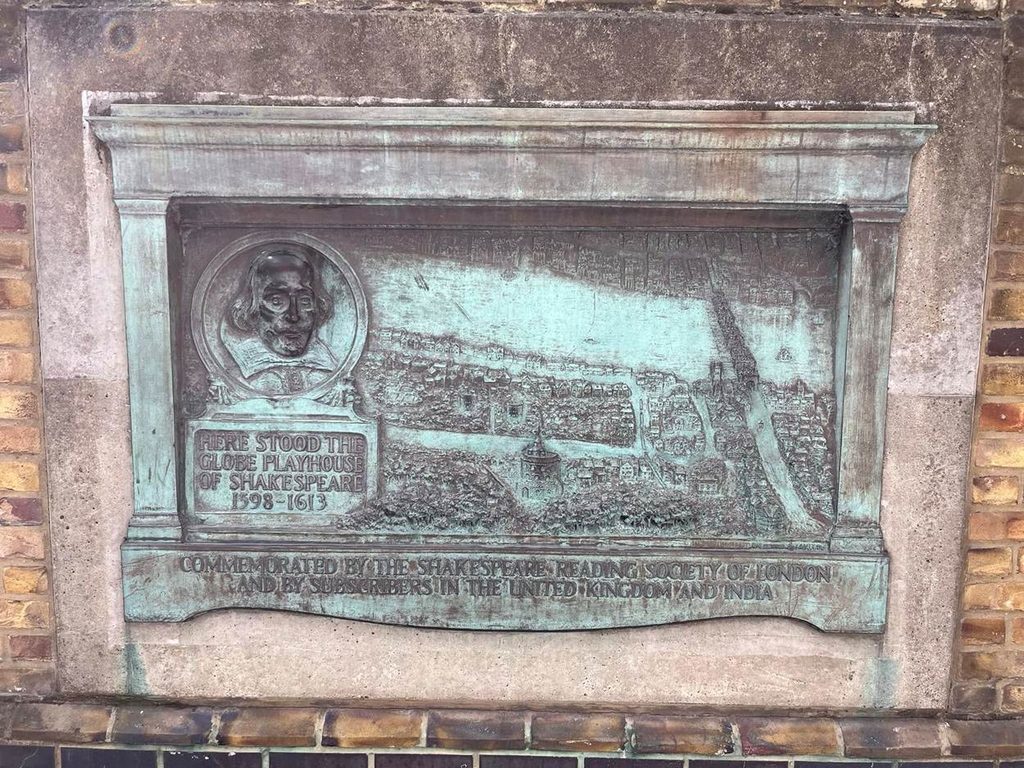
As you walk from the Blackfriars Tube stop to the Globe Theatre, you’ll see this plaque placed in front of some apartment buildings.
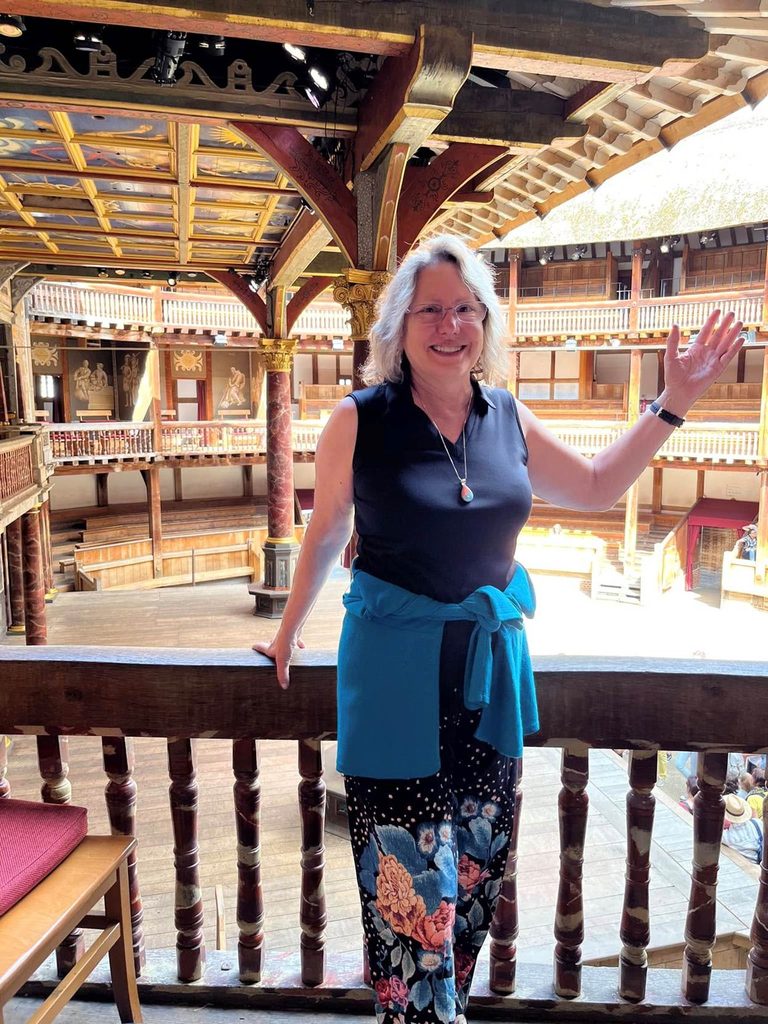
I’m standing in one of the audience galleries. The stage is on the left. The 12 signs of the Zodiac are painted on the roof over the stage (can you see them?). The wood is oak, acquired from forests all over England. There are no nails in the building; it was assembled using 12,000 hand-carved wooden pegs, just as they would have done in Shakespeare’s time.
It’s been said that the admission collectors went around the theatre just before each performance began and collected the admission price from audience members. They would then take their boxes full of money to an office backstage — giving rise to the term “box office.”
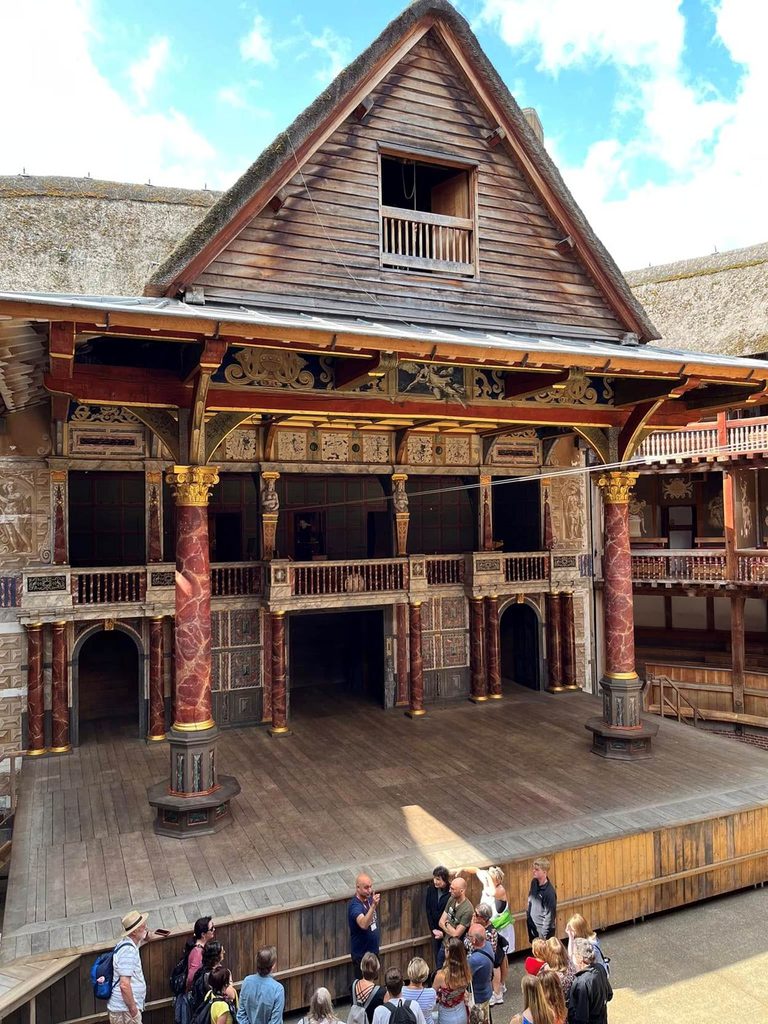
In Shakespeare’s time, audience members could purchase standing-only admission in this space in front of the stage. The “groundlings” paid a penny for the privilege.
The Globe Theatre is modeled after the first theatre on this site. However, the original Globe Theatre burned down in 1613 when a cannon used for Henry VIII set fire to the thatched roof and completely burned down the building. A second Globe Theatre was quickly built and opened in 1614. After the Great Fire of 1666 destroyed great swathes of London, safety reforms dictated that new buildings must be constructed of brick and stone, and forebade thatched roofs. An exception was made for the reconstructed Globe Theatre, and it is the only thatched-roof building in London.
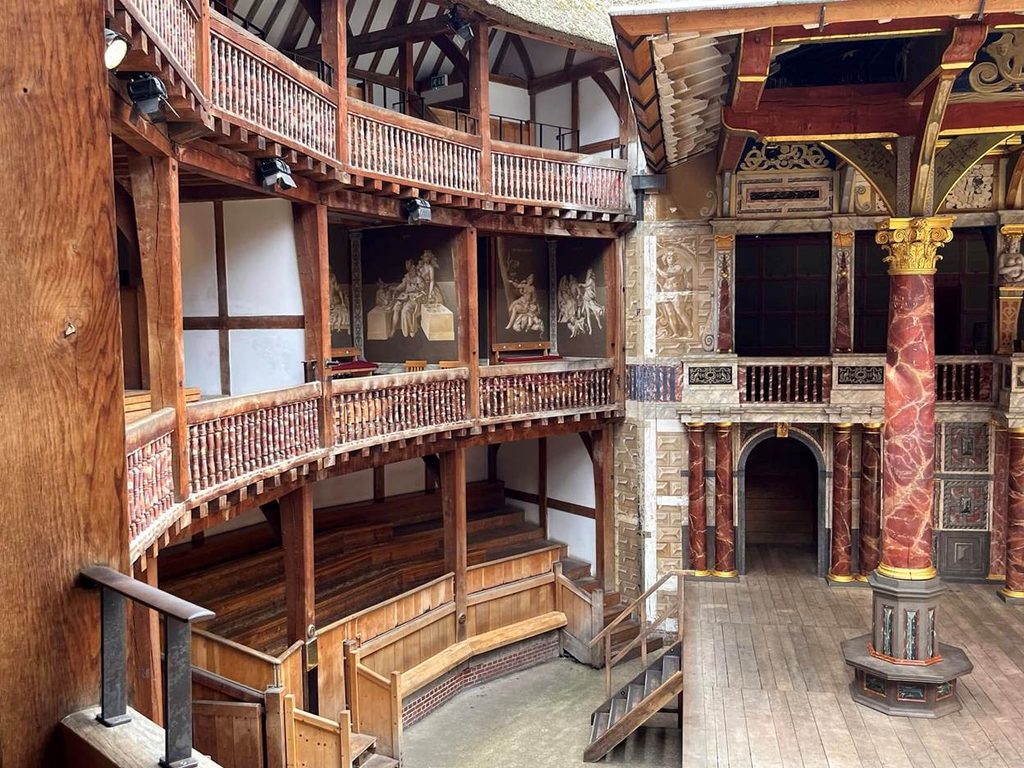
Further authenticity can be seen in the Globe’s white-plaster walls, created from a 17th-century recipe, as well as the lime whitewash. If I remember correctly, they said goat hair was incorporated into the plaster, although I don’t remember its purpose. And those lovely columns on the stage? They started out as square timbers but were stripped back little by little. They look round, but actually have 256 facets.
Those humorless Puritans issued an order in 1642 that ended all stage plays and The Globe was shuttered. Two years later, it was turned into tenement housing. Thus ended a golden age of live theatre.
August 23, 2023
Shakespeare’s Globe Theatre is located at 21 New Globe Walk in Bankside, London. The complex also includes the Sam Wanamaker Playhouse, which offers indoor plays. The closest Tube stop is Blackfriars. Use the South Bank exit and then it’s a 10-minute walk. Guided tours are 31£. The tour is a wealth of information about how the original 1599 theatre survived the Great Fire, how it was constructed, tidbits about how plays were staged in the 16th century, and how the audiences watched them. Of course, you can also buy tickets to watch a performance of one of Shakespeare’s plays in a setting just like what Elizabethan-era audiences experienced!