

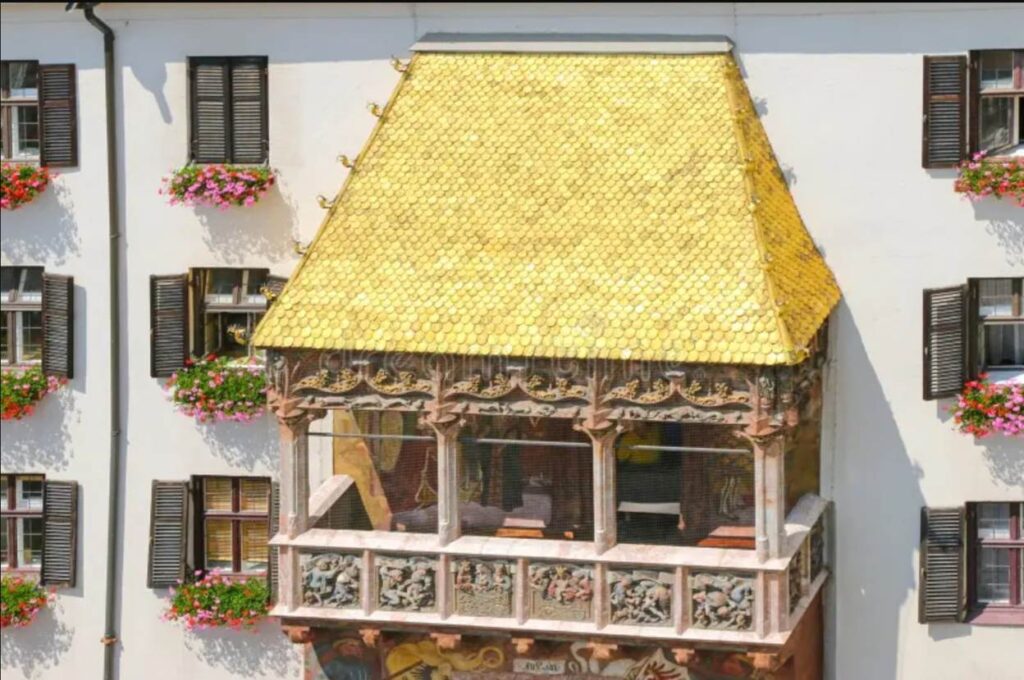
My acquaintance with Austria is just fleeting, limited to a one-day side trip from Garmisch-Partenkirchen in Germany back in 1980. All I really remember is the tour guide rhapsodizing over “the Golden Roof” several times as we drove through Innsbruck. But let’s take a closer look at that famed “Goldenes Dachl”.
The building is older than the loggia. Archduke Friedrich IV had the building constructed in the early 15th century as the residence of Tyrolean royalty. Several decades later, in 1493, Emperor Maximilian I commissioned the construction of the loggia to celebrate his marriage to his third wife, Bianca Maria Sforza of Milan. At the time, Maximilian was King of the Romans. He would be named the Holy Roman Emperor roughly a decade later, in 1508.
The design of the Goldenes Dachl was created by Nikolaus Turing the Elder, who was the Court’s builder at the time. The famous roof contains 2,657 fire-gilded copper tiles. The lower balustrade has eight panels (six in the front and two on the sides) with sculptures representing Maximilian’s territories. The upper balustrade shows scenes from Maximilian’s life, including one panel with his new wife Bianca Sforza. There’s also a painting of his first wife, Maria the Duchess of Burgundy (she died in 1482) on the balcony.
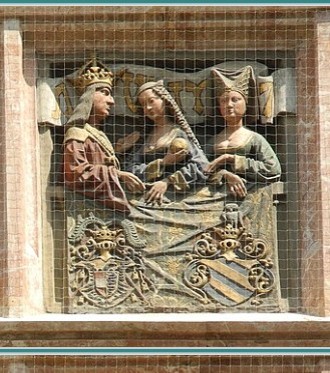
I’m not sure if this was done out of love for Maria, or to make sure he didn’t alienate the allies he gained by marrying her, or a bit of both.
In case you’re wondering about the second wife, who doesn’t get mentioned very often, her name was Anne, Duchess of Brittany, but that marriage was annulled after two years in 1492. Apparently, Charles VIII of France saw their marriage as a threat – since his realm was between Brittany and Austria – so he mounted a military campaign which resulted in Anne renouncing her marriage to Maximilian. But don’t worry about Anne. She somehow managed to marry Charles VIII in 1491, even before her marriage to Maximilian was annulled. Once Charles died, she married his successor, Louis XII.
But back to the Goldenes Dachl. Its balcony served as a royal box where Maximilian and Bianca and their entourage could watch festivals, tournaments and other events taking place in the square below.
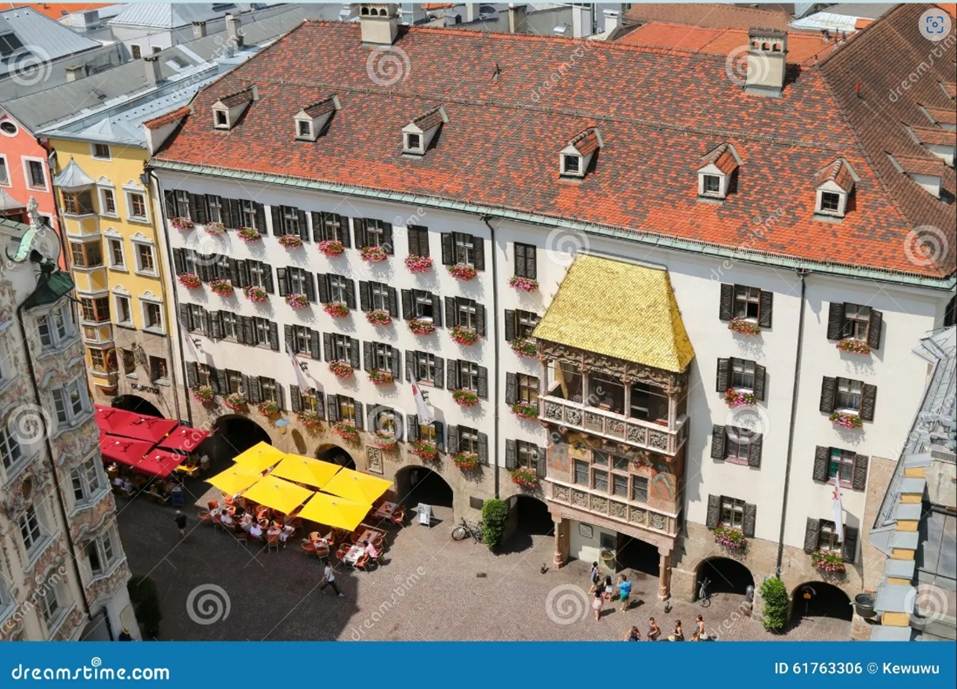
The reliefs you see on the balustrades today are replicas. For preservation purposes, the originals were removed in 1952 and replaced with carefully-rendered copies. Six of the reliefs can be seen in the Golden Roof Museum housed within the building. The Goldenes Dachl building also houses the International Alpine Convention’s offices and the Innsbruck city archives. If you visit the Golden Roof Museum, you can stand in the balcony and enjoy the same view that Maximilian once did. The modern interactive museum also covers Maximilian’s life and the transition from the Middle Ages to modern times. According to the Innsbruck tourist information office, the Goldenes Dachl is Innsbruck’s most famous sight and attracts “thousands of visitors every day.”
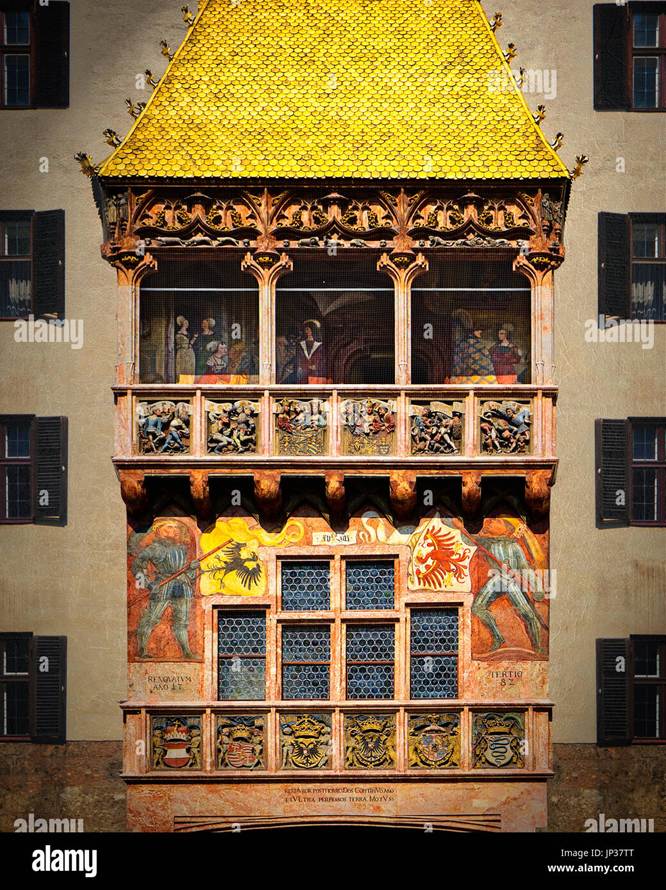
Visited c. 1980
Article written March 25, 2025