

At Chicago History Museum
Without the Great Fire of 1871, Chicago wouldn’t be the city that it is today. The huge amount of destruction led to the implementation of stronger building codes and the establishment of the Chicago Public Library. As soon as the flames died, business owners and speculators promptly set out to rebuild. Twenty-two years later, the city would welcome 20 million visitors to view the Columbian Exposition of 1893. Soon afterwards, skyscrapers grew in the city’s central core.
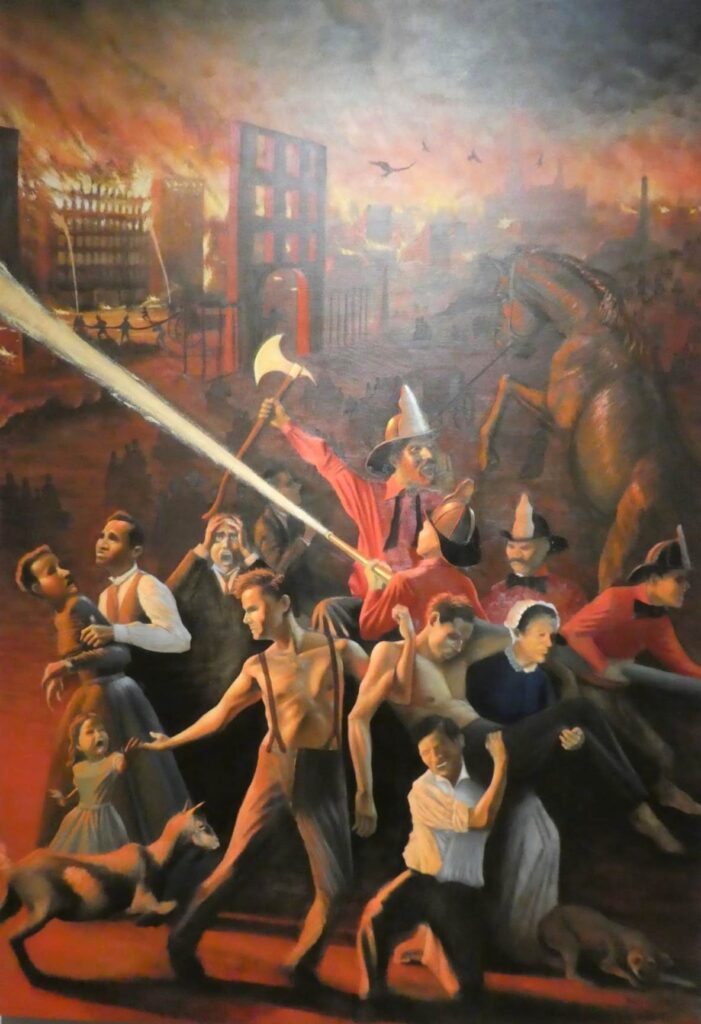
“The Burning City” by Juan Pablo Ruiz, 2021, depicting the Great Fire of 1871.
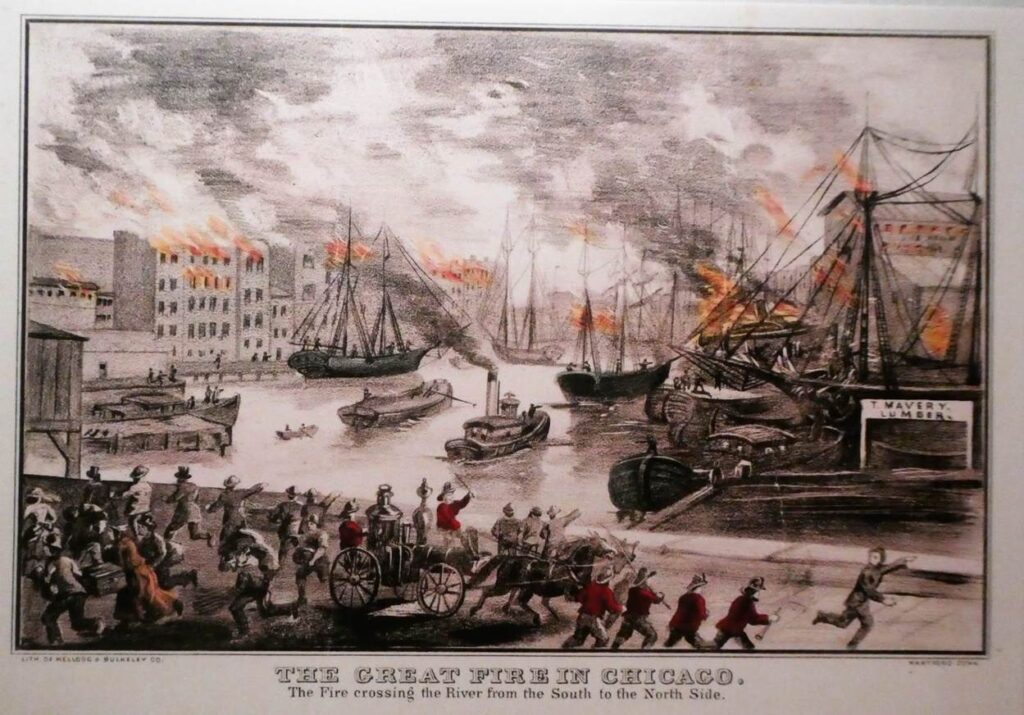
A lithograph donated by Kellogg & Buckley Co depicting the Great Fire crossing the Chicago River. Original artist unknown, c. 1872.
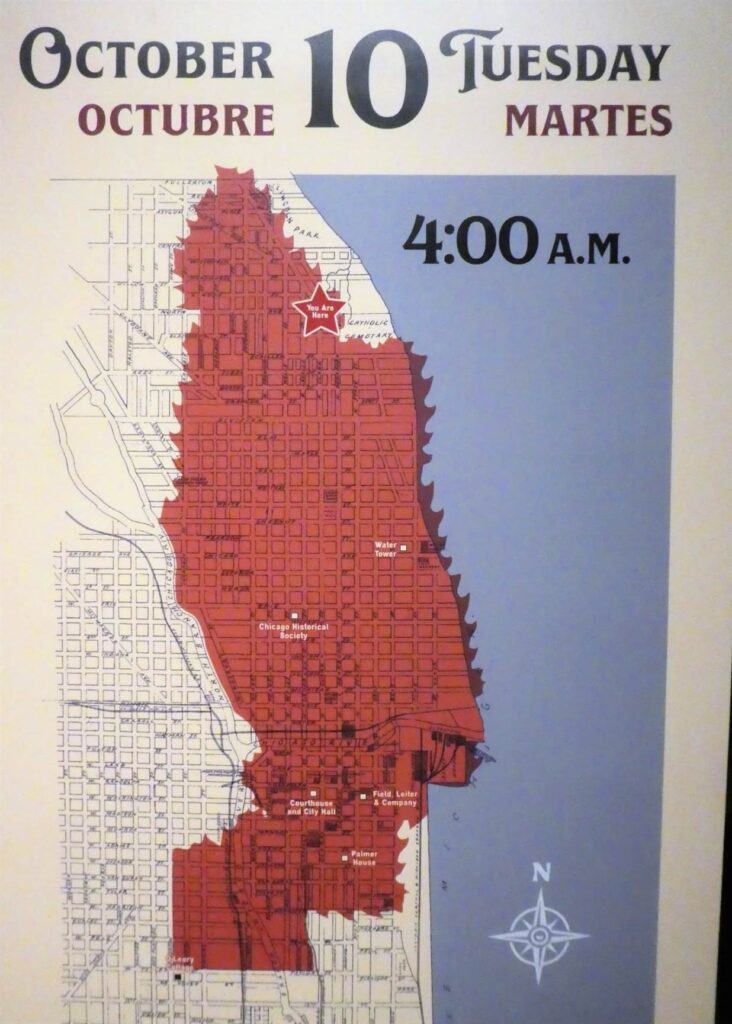
Map showing the extent of the fire.
The Great Fire by the numbers:
* It covered 3.3 square miles and killed approximately 300 people.
* Almost 1/3 (100,000) of the city’s 324,000 people were made homeless.
* Over 17,000 structures were destroyed for a total of $222M in damages (>$4.7B today).
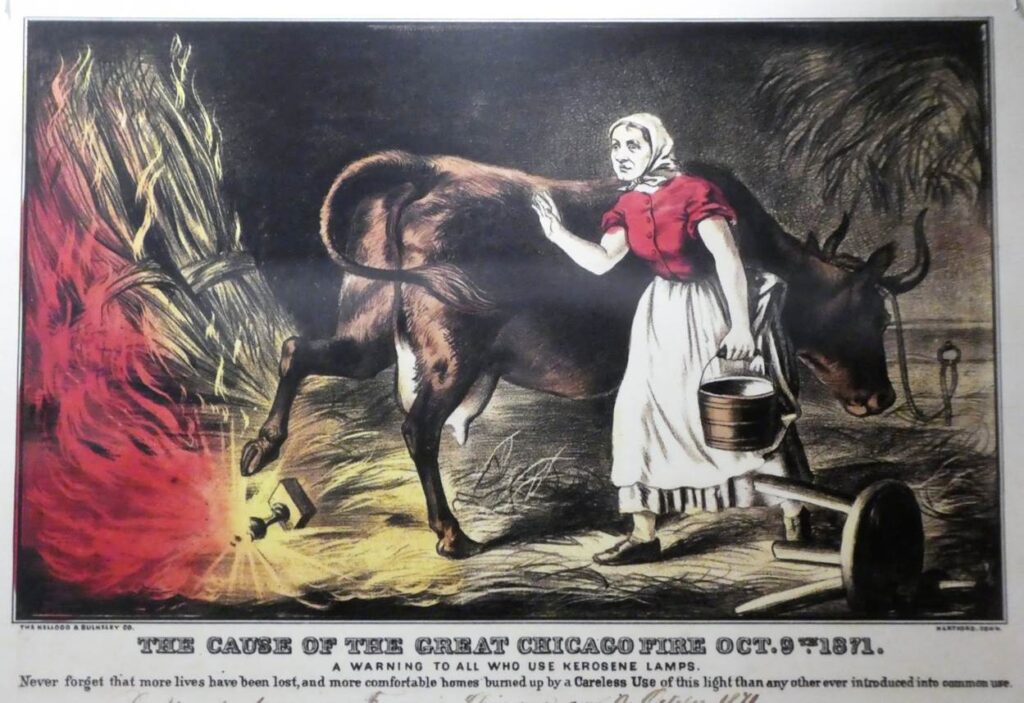
Although popular legend says that Mrs. O’Leary’s cow started the fire by kicking over a lantern while Mrs. O’Leary was milking her, Mrs. O’Leary stated that she was already in bed when the fire started that evening. The family faced much condemnation following the fire, driven by anti-Irish and anti-Catholic sentiment. The official cause of the fire has never been determined, only that the fire started in or near the barn. The City of Chicago officially exonerated the O’Learys (and their cow) in 1997.
Fittingly, the O’Learys’ cottage was torn down in 1956 to build the Chicago Fire Academy
The Great Chicago Fire exhibit and many more can be found at the Chicago History Museum, located at 1601 N. Clark Street. They’re closed on Mondays, but are open Tuesday through Saturday from 9:30am – 4:30pm and on Sundays from 12-5pm.
July 26, 2022