

Thus far, Tiranë is a city of contrasts, with ultra-modern buildings standing next to the old. All of these buildings surround central Skanderbeg Square. You’ll note that most of them were completed within the last five years, so the face of the central city has been changing quickly.
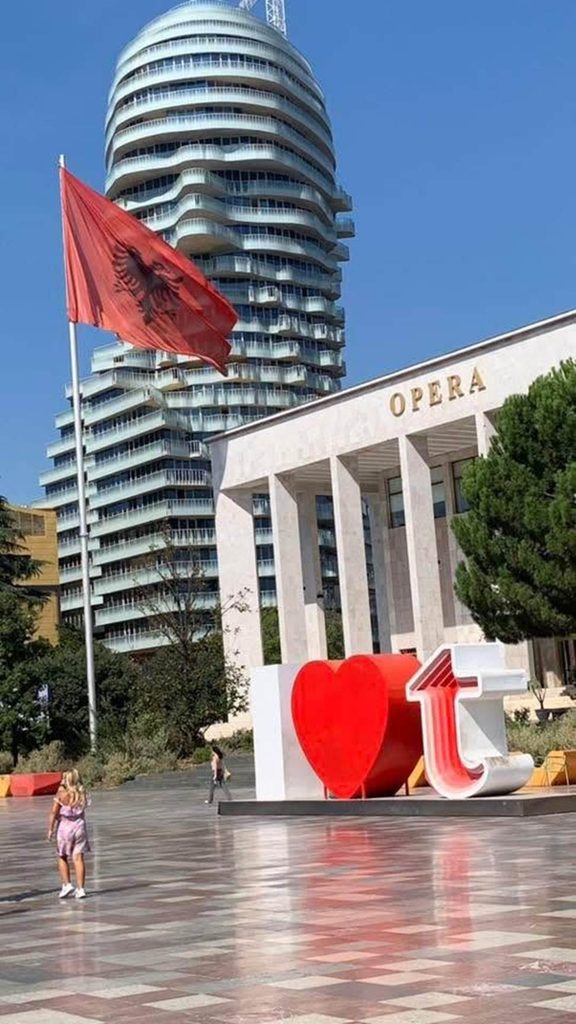
An “I Love Tirana” sign stands in front of the Opera House. Behind the Albanian flag is the Skanderbeg Building, deliberately designed to appear like the face of Albania’s national hero, Gjergj Kastrioti, also known as Skanderbeg.
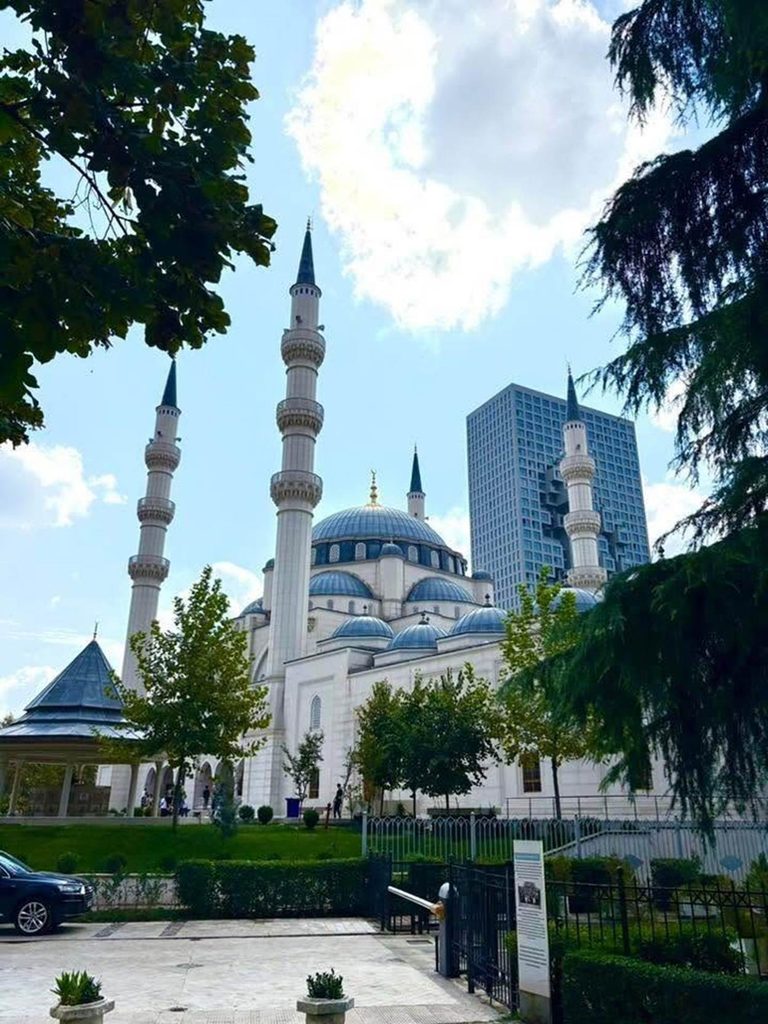
This is the Namazgah Mosque, which holds 10,000 worshippers and is the largest mosque in the Balkans. It was built because the historic Et-Hem Bey Mosque could hold only 60 worshippers, with faithful Muslims spilling out into Skanderbeg Square – a situation that was untenable in bad weather. It opened in October 2024 and is now the main mosque of Tirana.
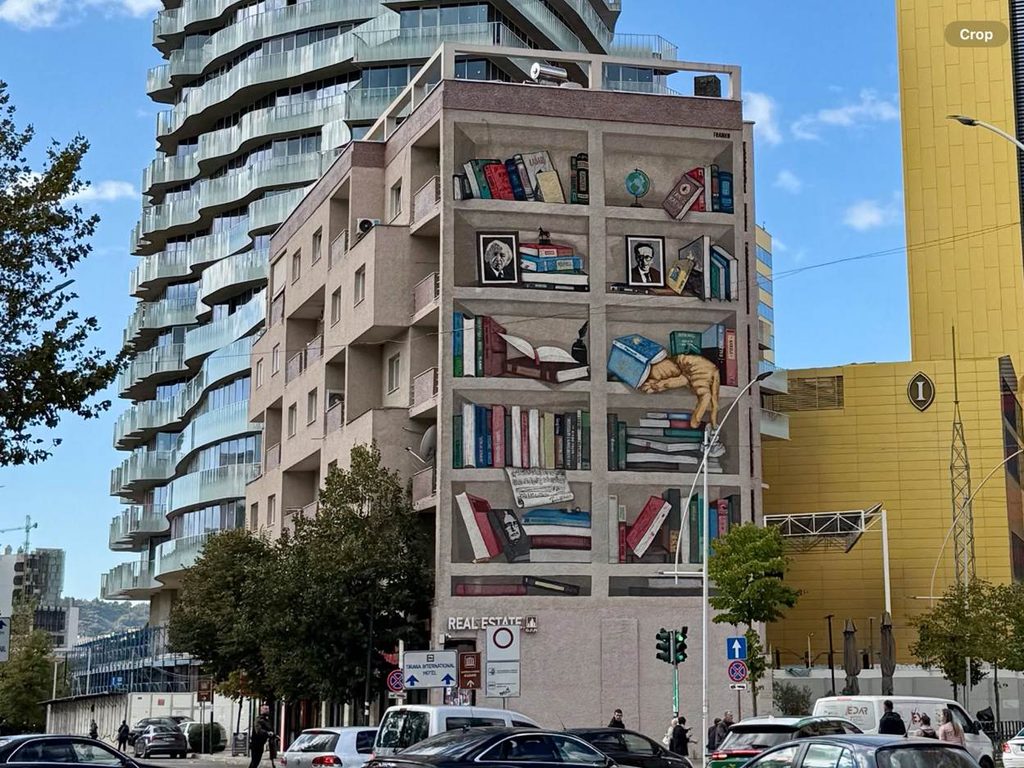
The former apartment of Ismail Kadare, a famous Albanian novelist, is now open as the Kadare Museum. As you can see, it is nearly adjacent to the Skanderbeg Building. The side of the Kadare-Studio House has this lovely mural of books and a sleeping cat. I assume that the “photos” in the mural are of Kadare and Dritero Agolli, another writer who lived here. Both were influential writers during the nation’s Communist period. The museum focuses on how they lived and their works. Admission to the museum costs 500 Albanian lei.
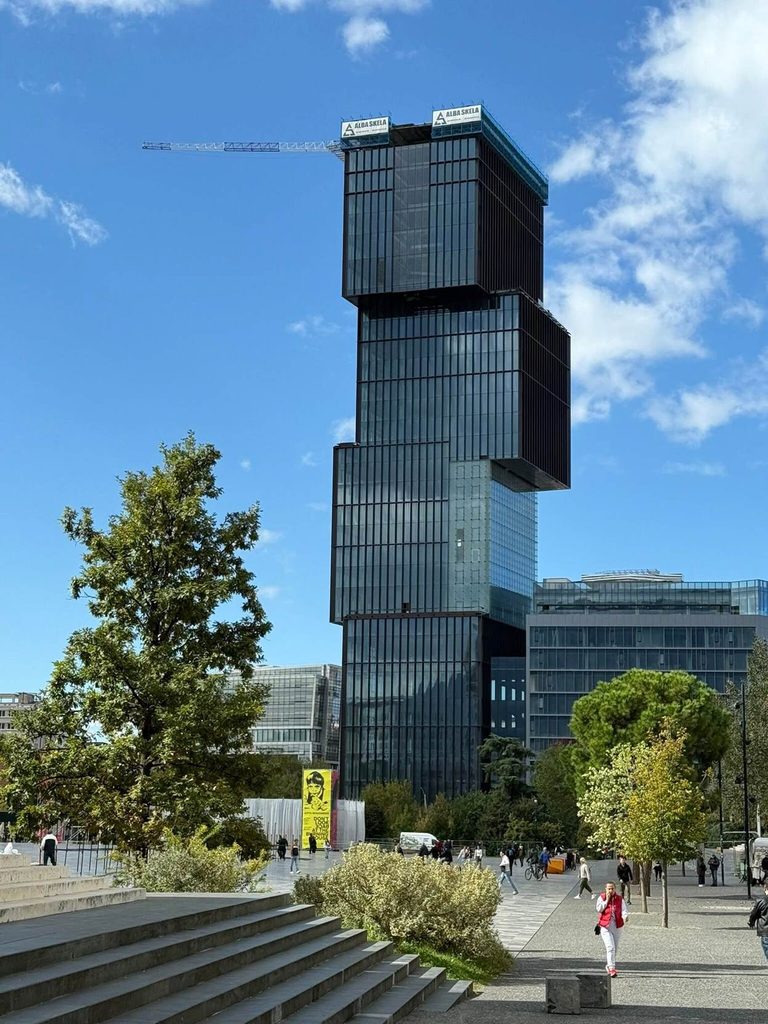
This is the EOT, or Eyes of Tirana, Tower in Skanderbeg Square. Its deep purple blocks were designed for sustainability. The building was completed in 2026 (although it looked pretty complete when I was there in October 2025).
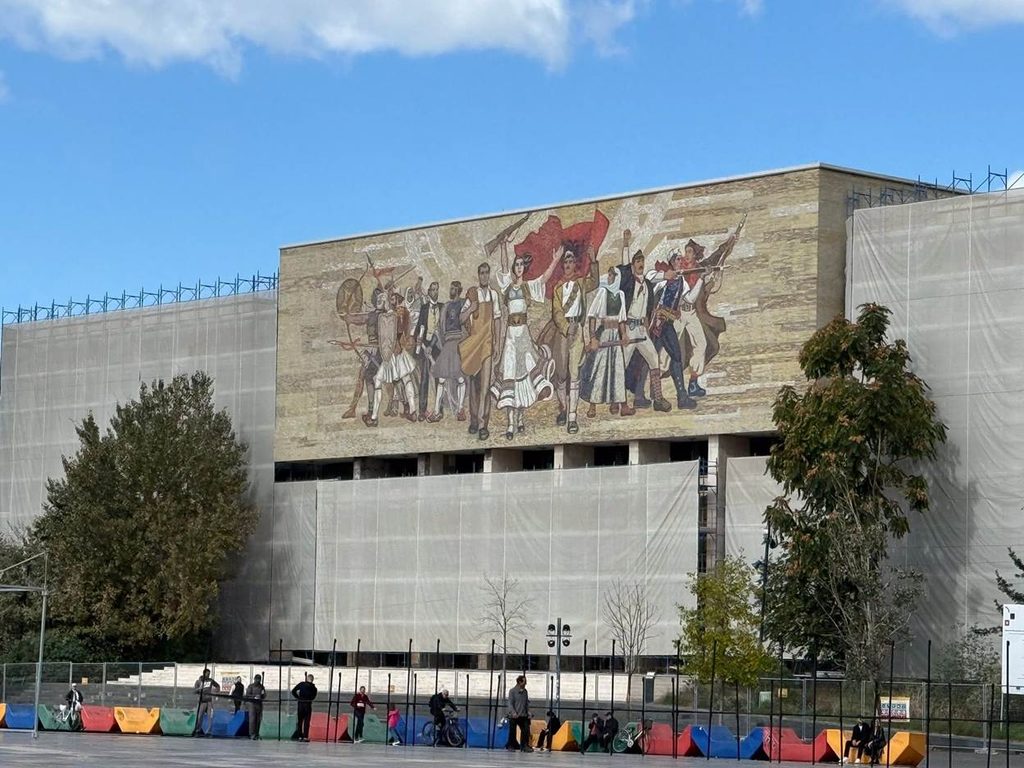
The National History Museum is said to house “a comprehensive chronicle of Albanian civilization” through the centuries, from the Paleolithic era to the Communist period. Sadly, it is currently closed for major renovations and is not scheduled to reopen until 2028. The mosaic on the side of the building is entitled “The Albanians” and measures 11 meters high and 40 meters long. It portrays Albanians from the ancient Illyrians warriors, fighters against the Ottoman Empire, to a Communist worker, with “Mother Albania” at its center.
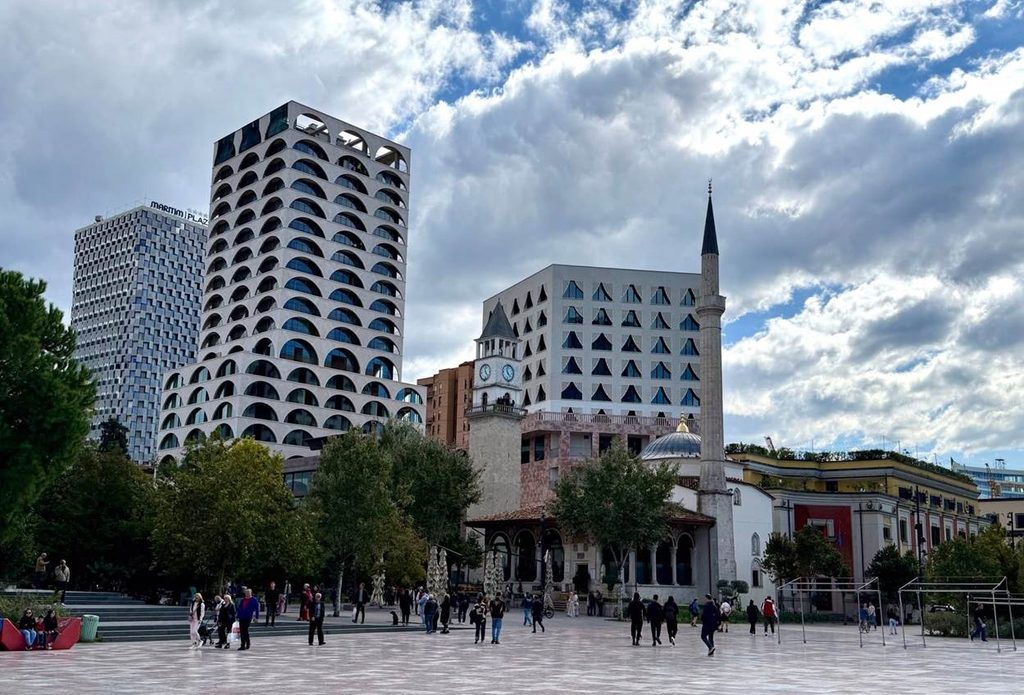
The building in the left foreground is called the Book Building. Allegedly, it looks like a thick book full of bookmarks. I don’t get it, but maybe you will. It’s 21 stories high and features a mixed use of commercial, office, and residential spaces. The Book Building was constructed in 2024.
You can see the Clock Tower and Et-Hem Bey Mosque on the right. The 18th century Ottoman-era Et’Hem Bey Mosque looks like a jewel box inside. Most houses of worship were destroyed or re-purposed during the Communist era of the late 20th century, but the Et-Hem Bey Mosque survived because of its artistic and historical value. Visitors are allowed inside as long as it’s not during prayer times.
The Clock Tower, also known as Kulla e Sahatit, was completed around 1830. Although it was damaged during World War II, it was restored to its original appearance.
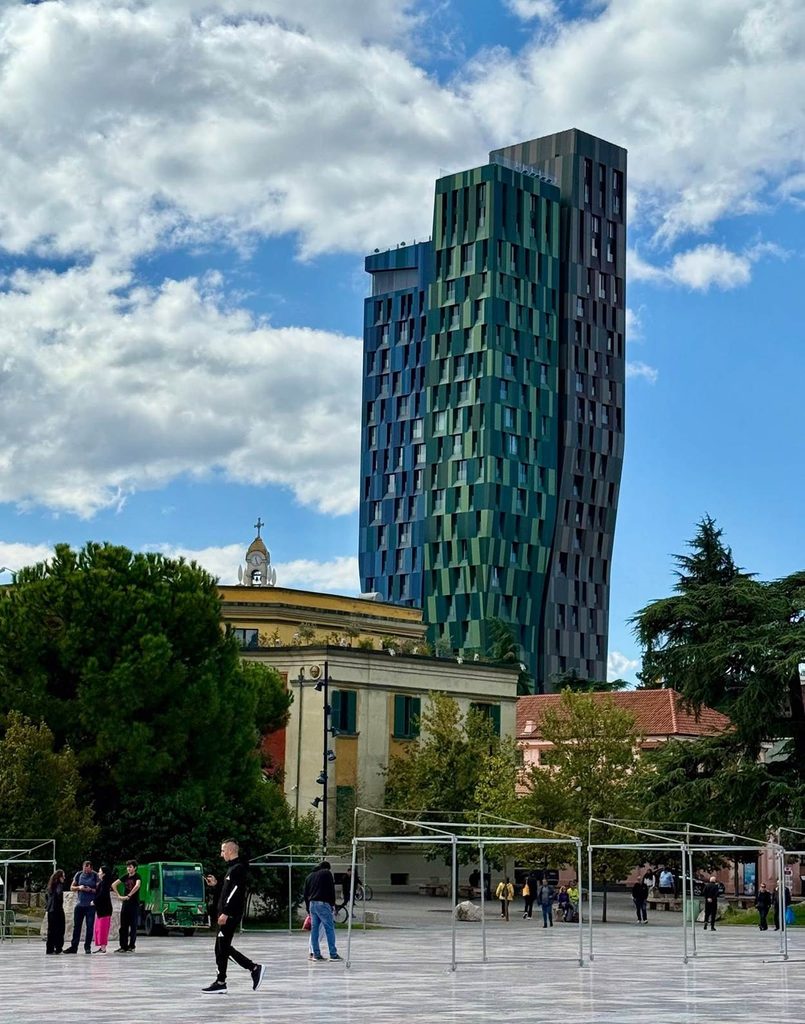
I couldn’t find any information about this twisty blue building in Skanderbeg Square. As I recall, it’s fairly close to the historic Et-Hem Bey Mosque.
October 8, 2025