

Back in the 1840s, girls only went to school until the age of 8 or 10, and then left school to go to work and help their parents. A local pastor wanted to change that, and he asked the Ursuline nuns to provide better schooling for the town’s girls. The nuns went above and beyond that. In 1849, they added a boarding school to attract wealthy Catholic girls and to help subsidize the costs of providing education to the local girls. The Ursuline Institute became internationally famous, teaching girls not only “feminine” arts such as music and dance, but also hard sciences such as biology and chemistry. The boarding school attracted girls from Italy, Spain, Romania, Panama, Brazil, Australia, Turkey, and beyond. The educational language was French, which was the primary language of educated people in Europe at the time. The nuns created a stunning Art Nouveau complex in which every room and every hallway was thoughtfully and beautifully planned out.
The Ursuline nuns are named in honor of St. Ursula, and it’s St. Ursula’s story that’s illustrated in the art of the reception parlor below. I’ve seen several versions of St. Ursula’s story, but I’ll relay the story that our guide told us.
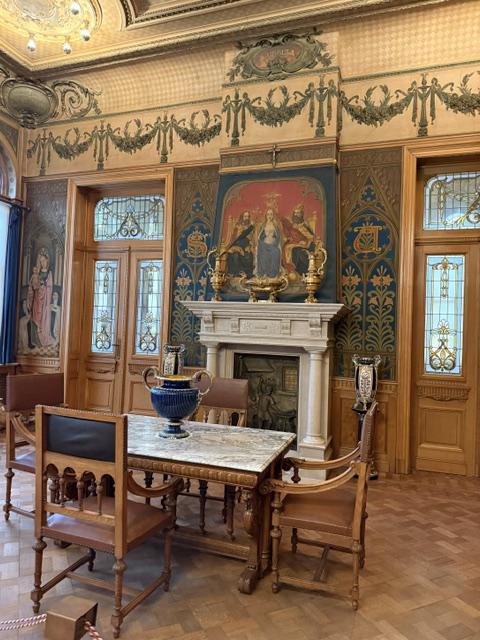
The reception parlor, where the boarding school’s wealthy parents would initially meet up with their daughters.
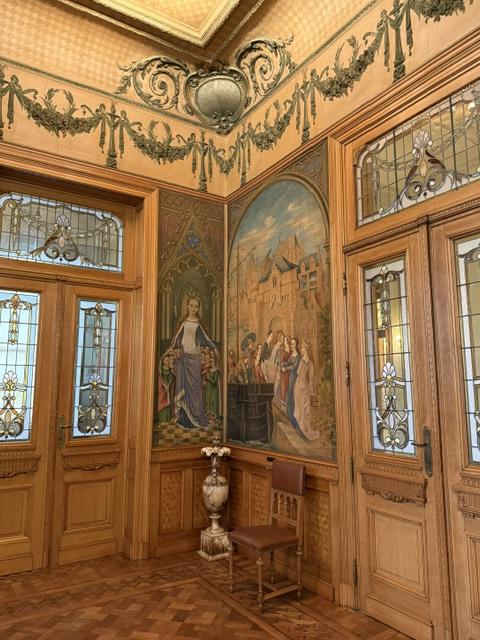
According to the story, Ursula was a 5th century British princess and her father had her betrothed to a prince. In this painting, she is in the court of her father. Ursula didn’t seem to object to the marriage itself, but was worried because the prince was pagan. She asked her father for permission to visit the Pope and ask for his blessing on the marriage. Ursula agreed to marry the prince if the Pope OK’d it.
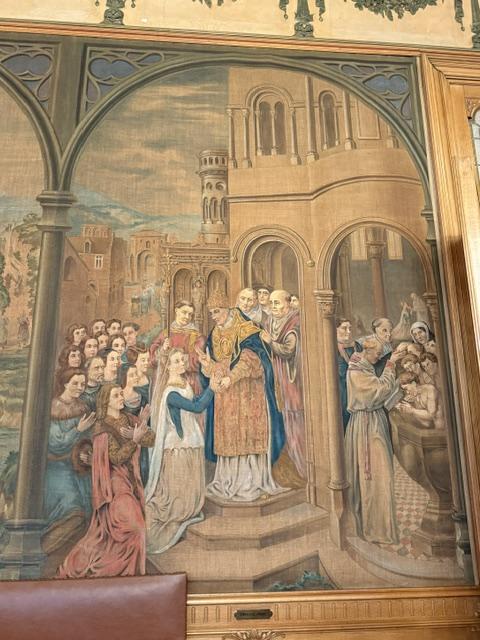
A young woman doesn’t travel alone, however. Ursula brought an entourage of somewhere between 11 and 11,000 maidens with her (the stories vary greatly). Here, she meets the Pope, who does give his blessing. Ursula is surrounded by a number of her maidens.
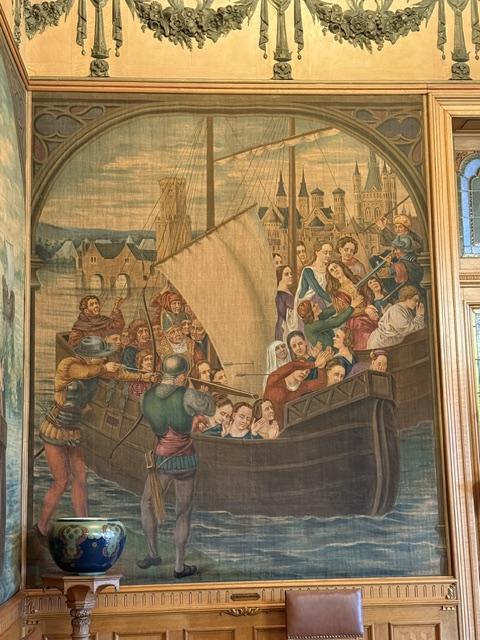
Alas, on her return trip home, Ursula and the other ladies had the misfortune of meeting up with Attila the Hun near the German city of Cologne. She pleaded with Attila for safe passage, which Attila said he would grant on one condition: Ursula must marry him. Ursula, however, proclaimed that she was bound by her oath to the Pope and to her father to marry the prince. Therefore, Attila slaughtered Ursula and all the women accompanying her. For this act, the Catholic Church proclaimed her as a virgin, a martyr, and a saint.
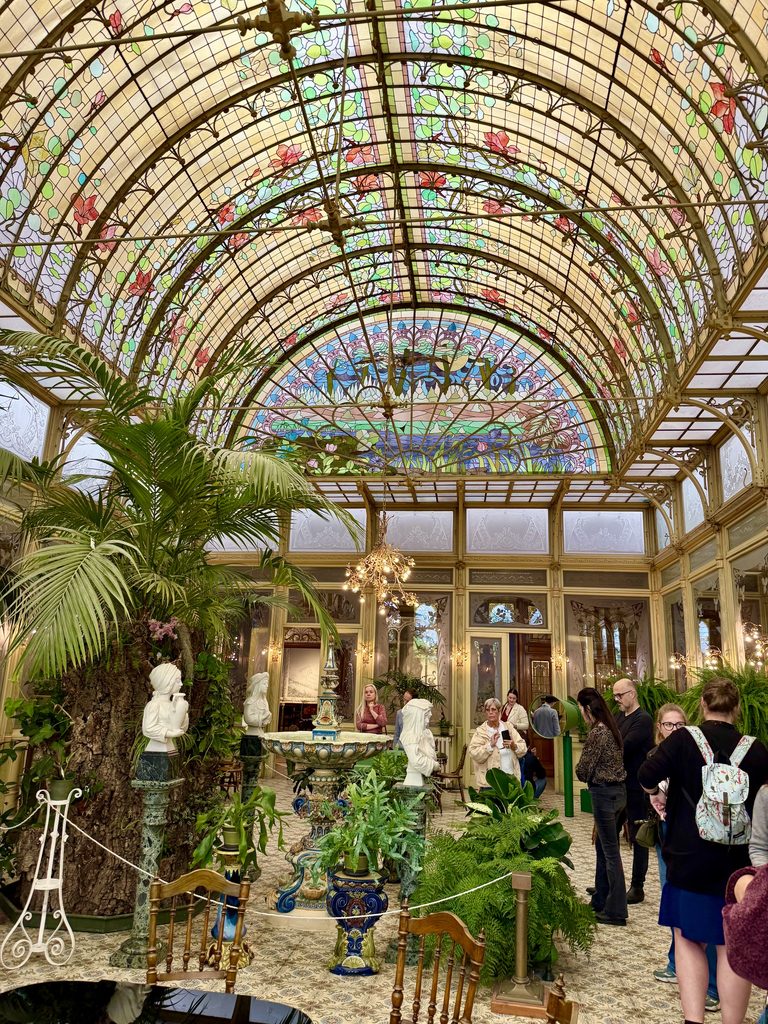
In 1900, the nuns added Wintertuin, the Winter Garden, as a place where parents and their daughters could visit. It is this room with its soaring glass ceiling and lovely fountain that most people picture when they hear of Wintertuin.
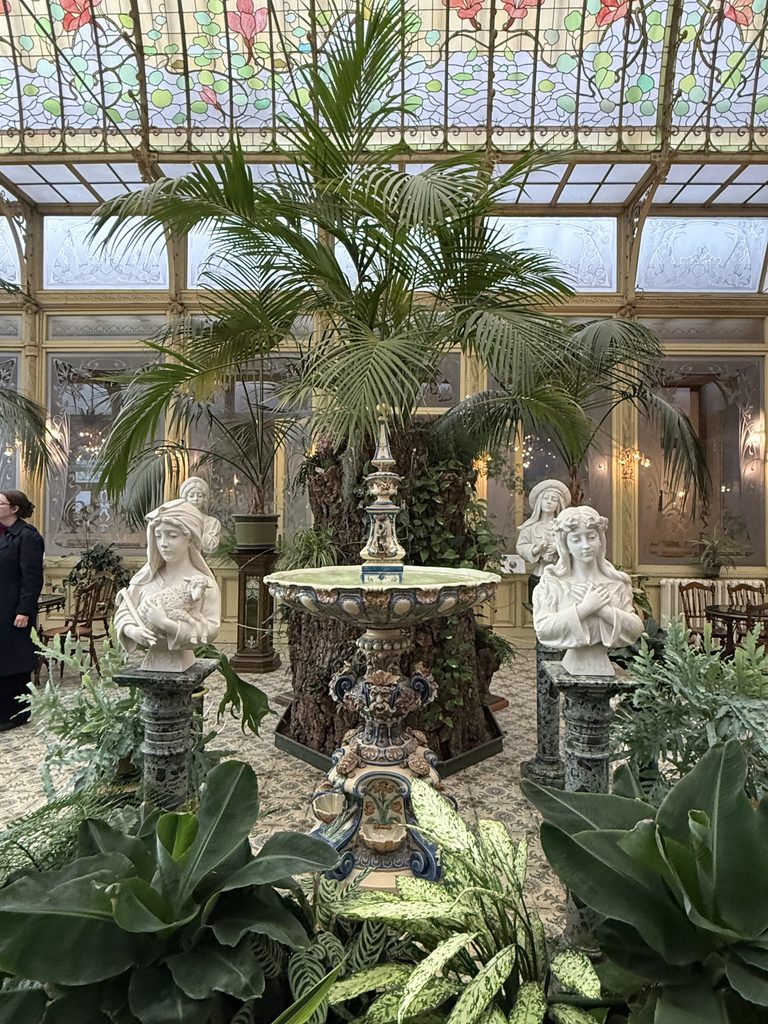
The fountain in Wintertuin. The busts are supposed to represent four Old Testament women: Sarah, Rebecca, Rachel, and Ruth.
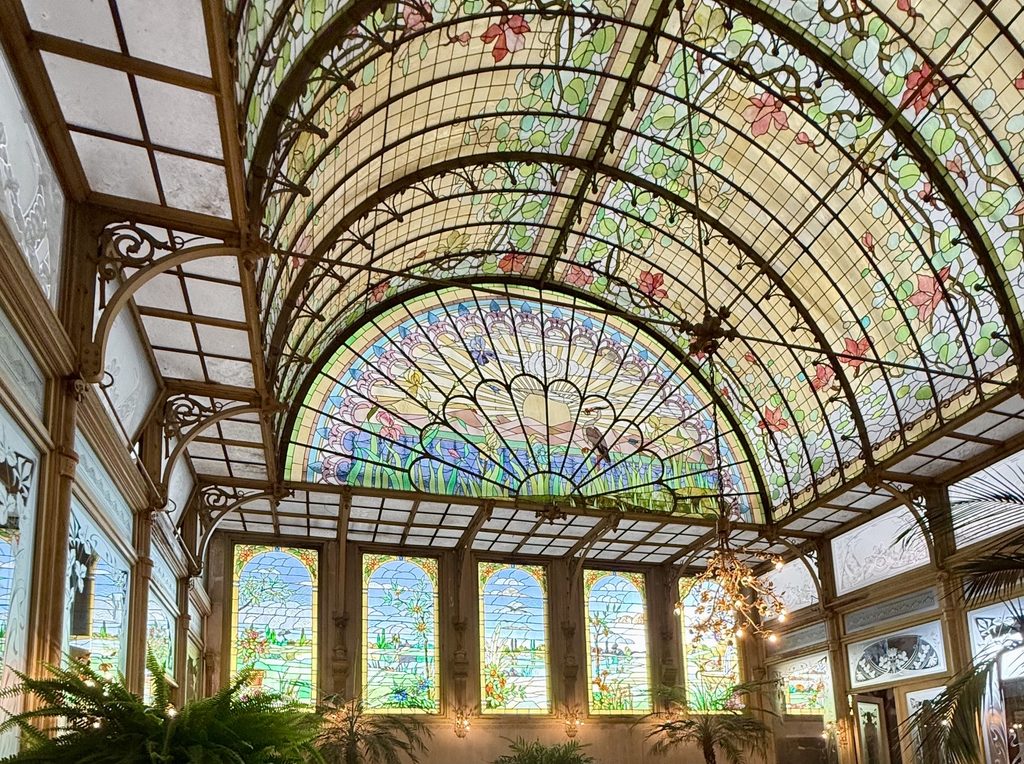
This is your view to the left as you enter Wintertuin. The panels represent nature during the morning of the day.
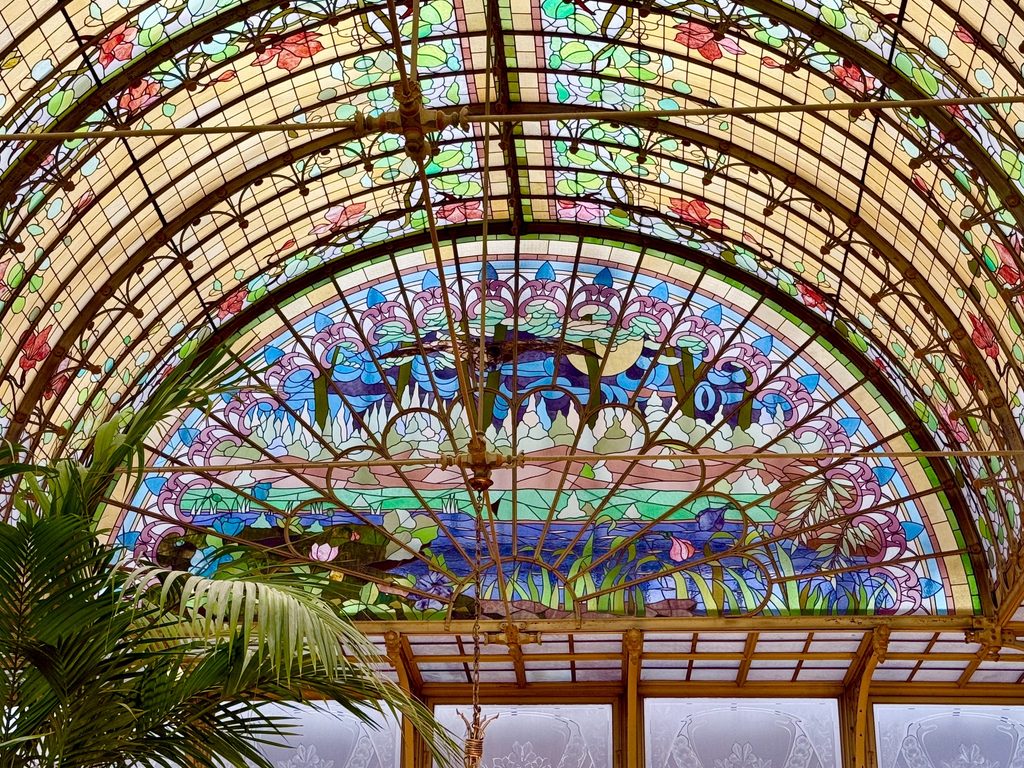
This is your view to the right as you enter Wintertuin. It shows nature towards the evening of the day.
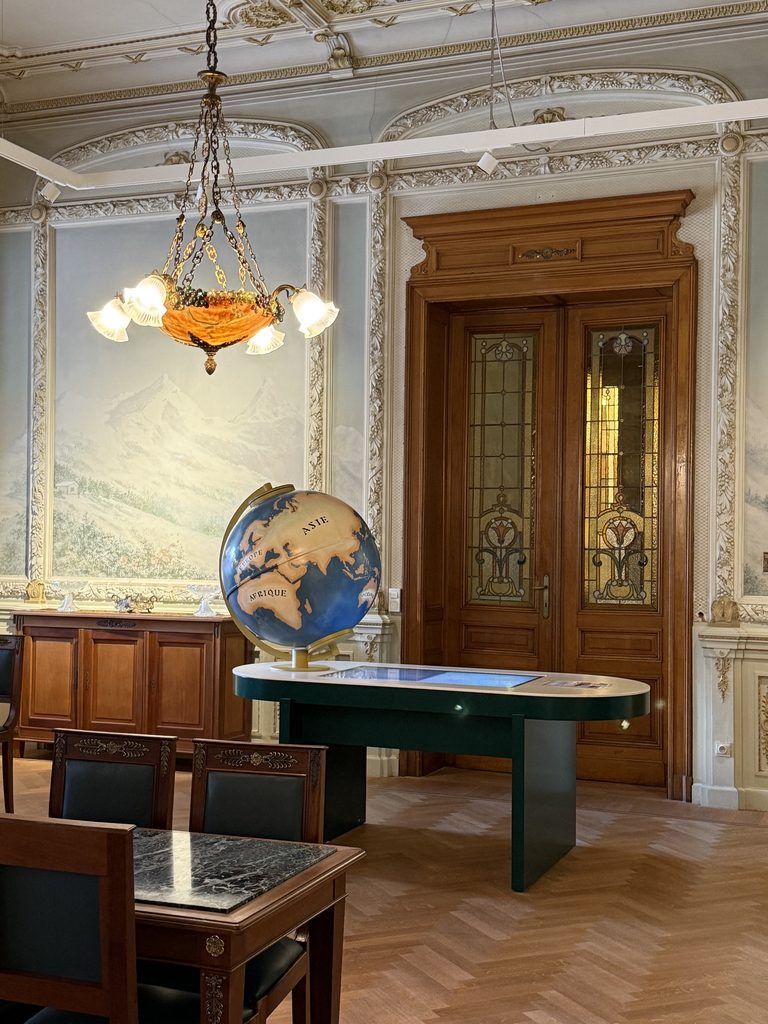
After leaving Wintertuin, you enter the music room. This is where the girls would give recitals to their parents. Although other instruments were also taught, piano was the primary musical instrument that the girls learned. You see a globe sitting on a desk here.
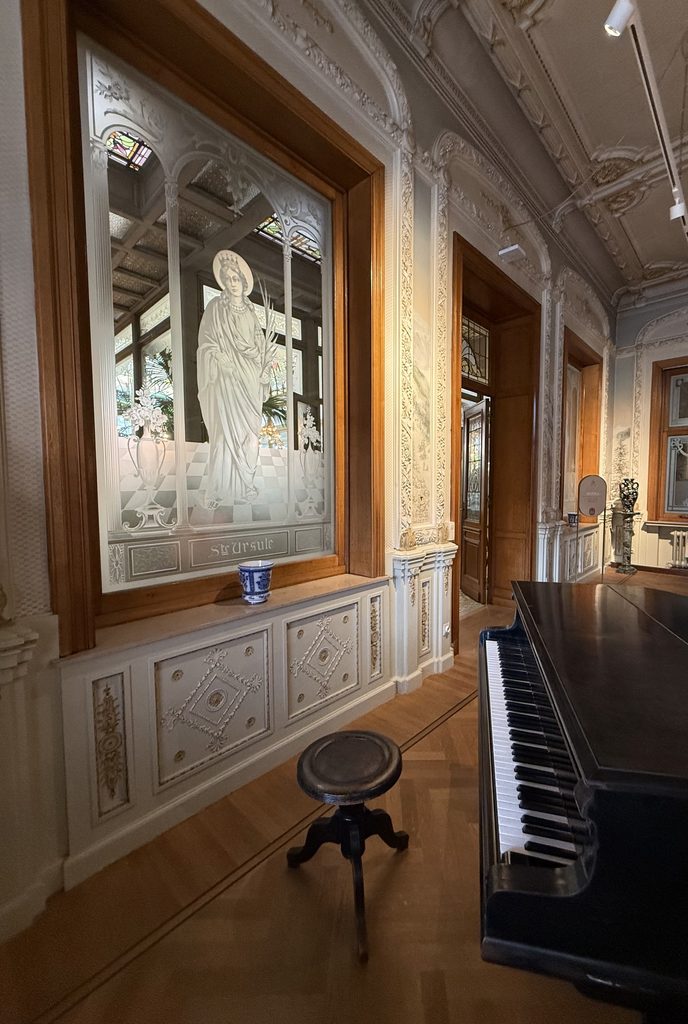
A piano still sits in the music room, accompanied by a frosted glass portrait of St. Ursula.
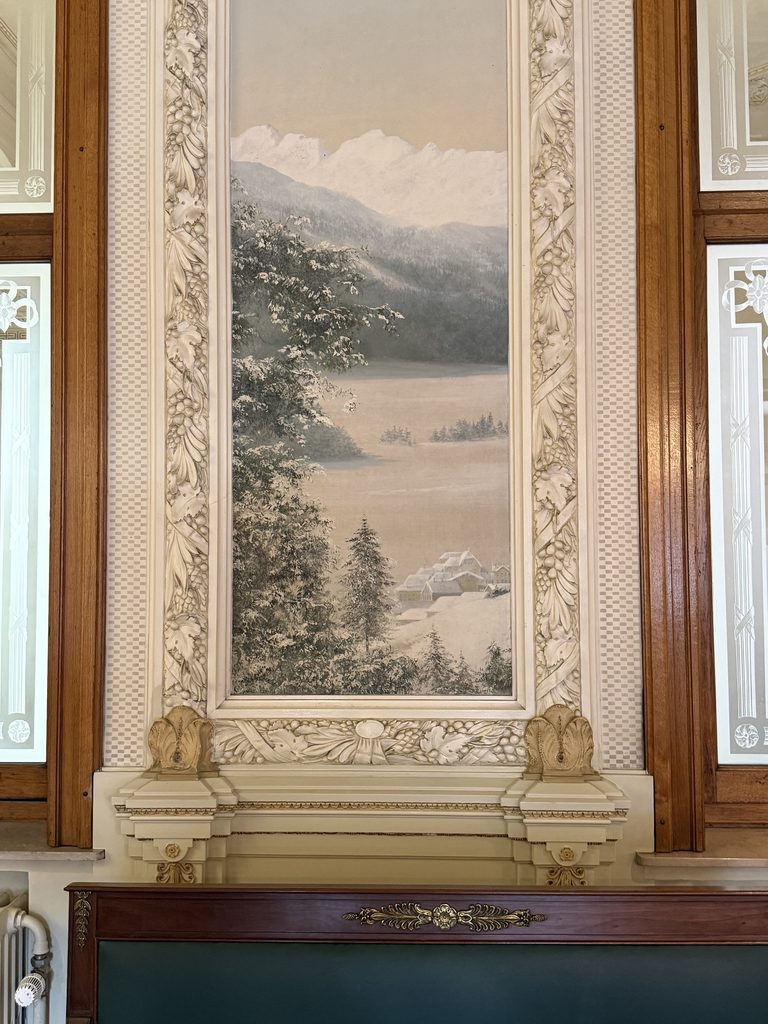
Spaces between the windows in the music room featured winter scenes like this one.
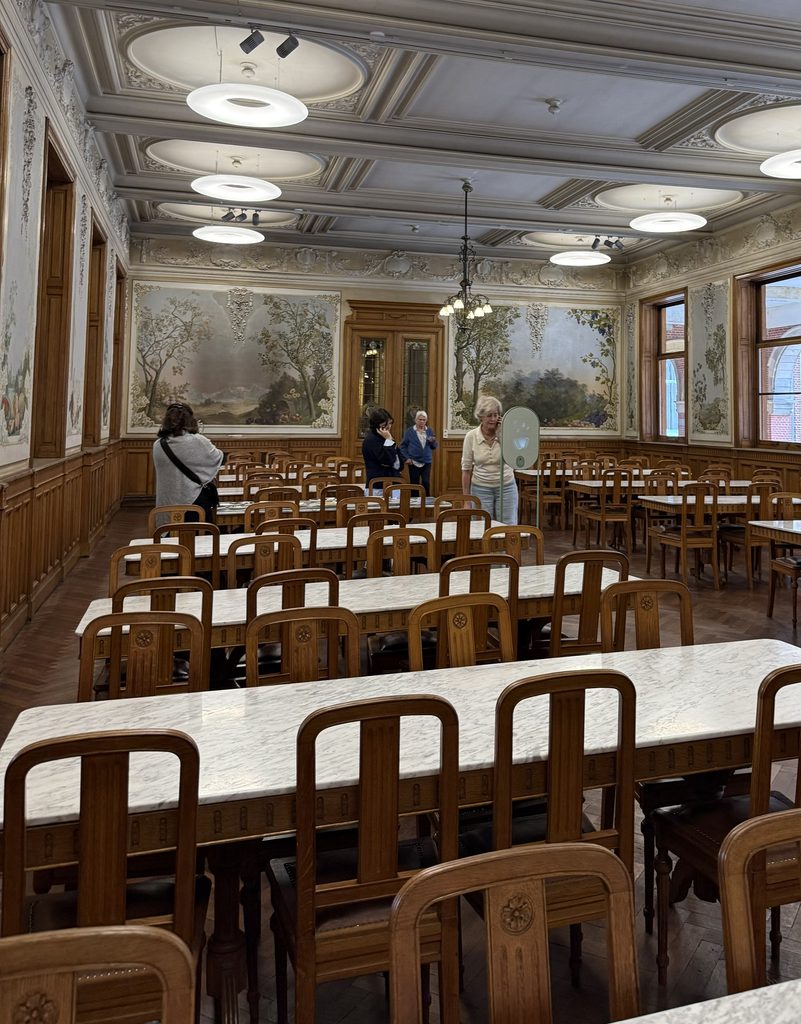
Parents could also join their daughters for a meal in this dining hall.
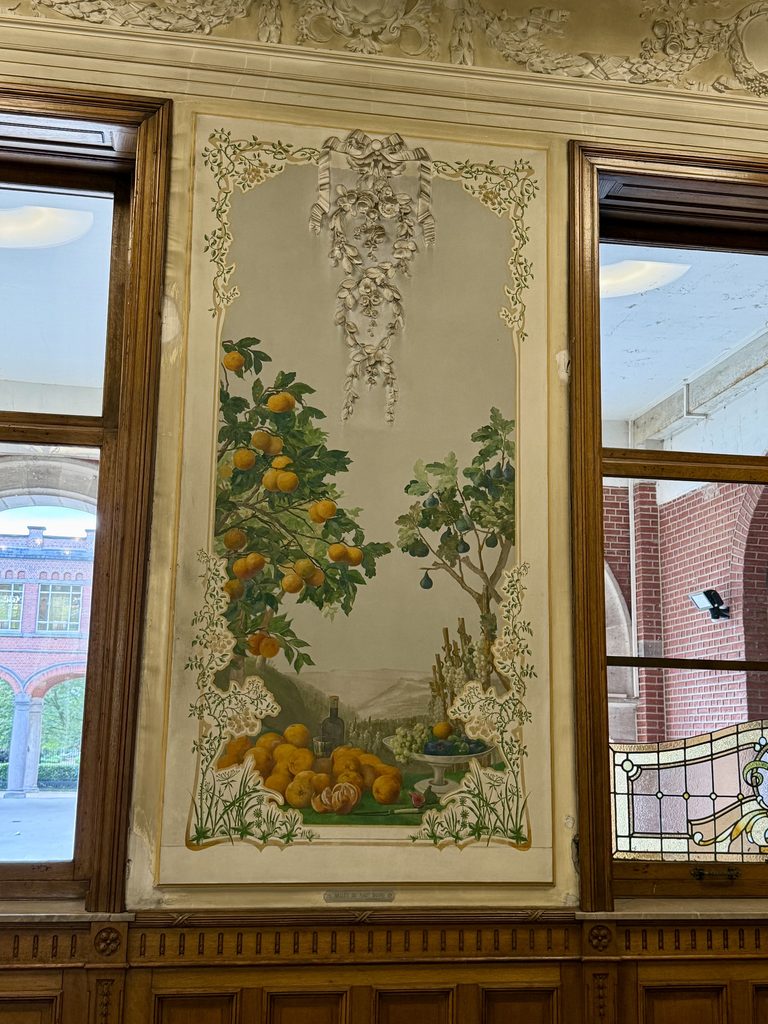
The dining hall featured paintings of foods grown in various regions of Europe, such as these oranges from Portugal.
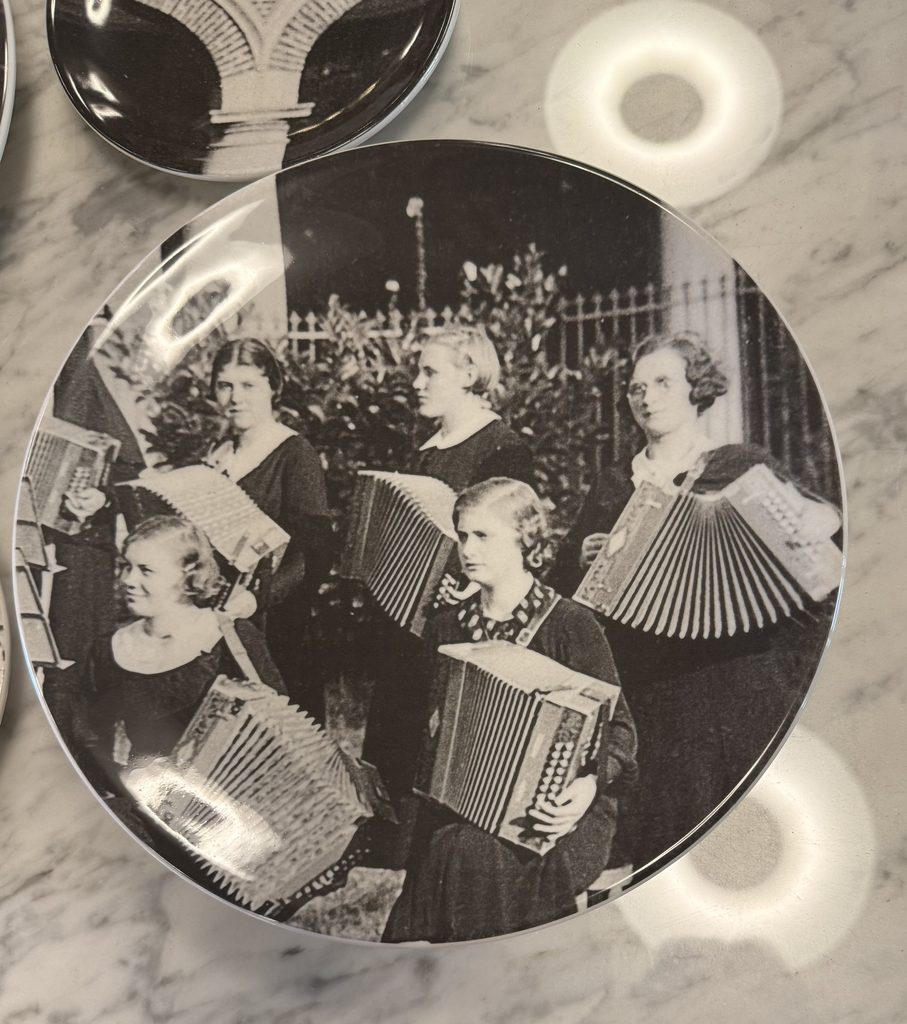
A plate in the dining room showcases a photo of St. Ursuline girls playing accordions.
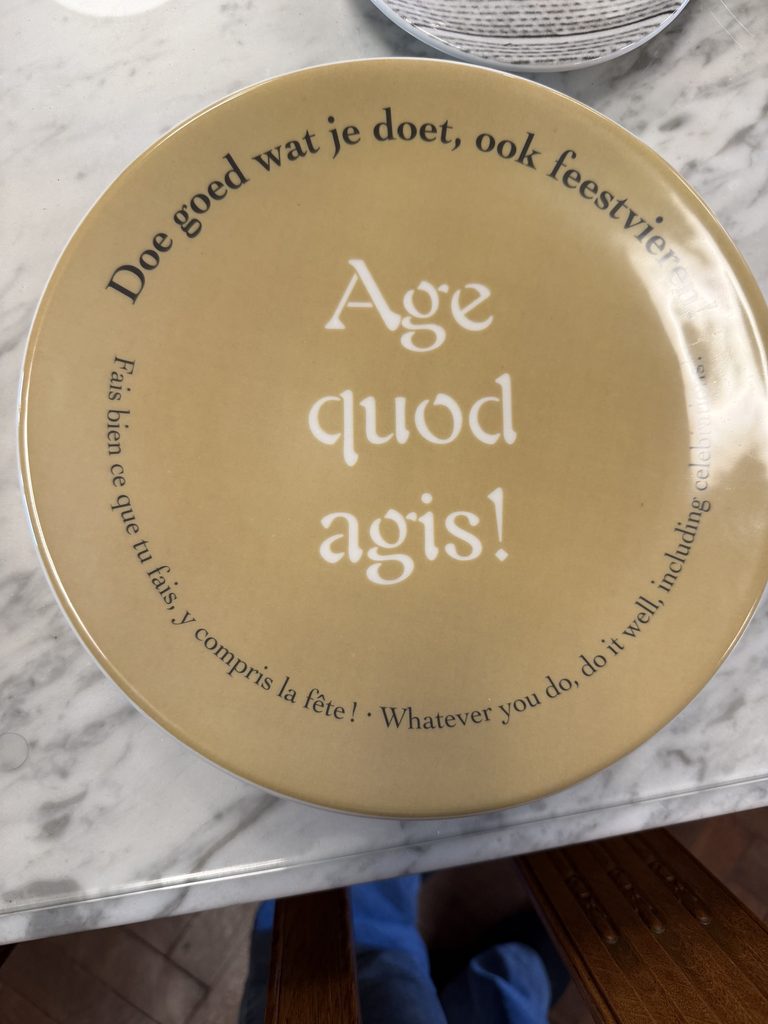
I liked the saying on this plate: “Whatever you do, do it well, including celebrations!”
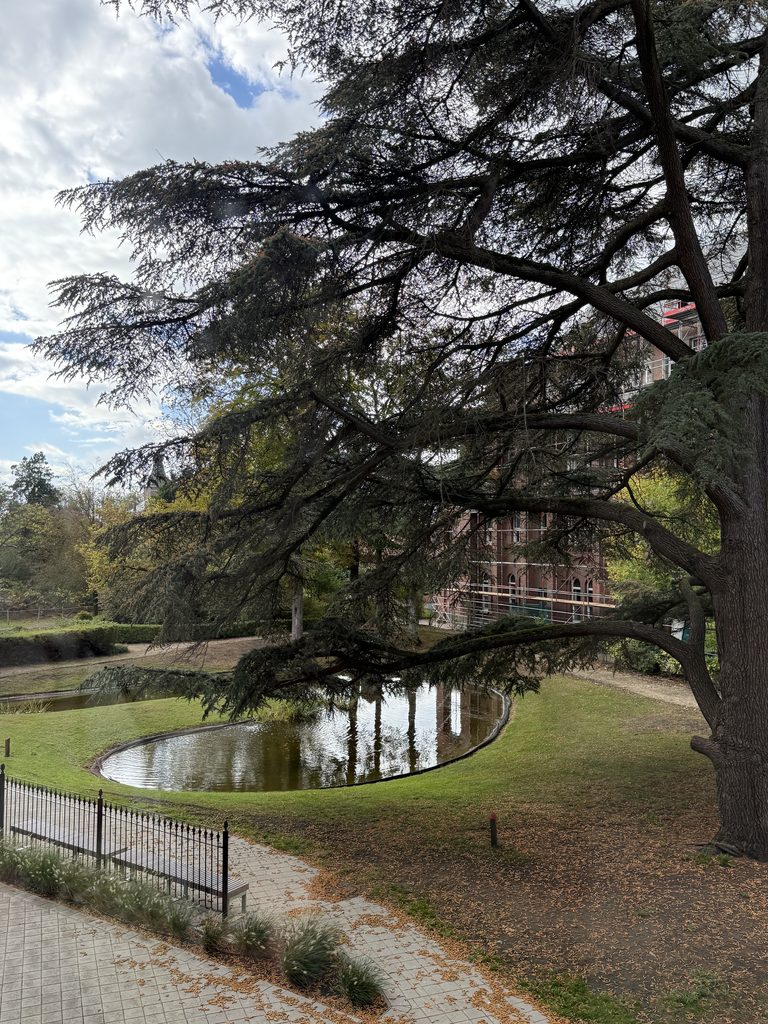
The girls could enjoy a walk in the pretty grounds, allegedly made to resemble an English garden.
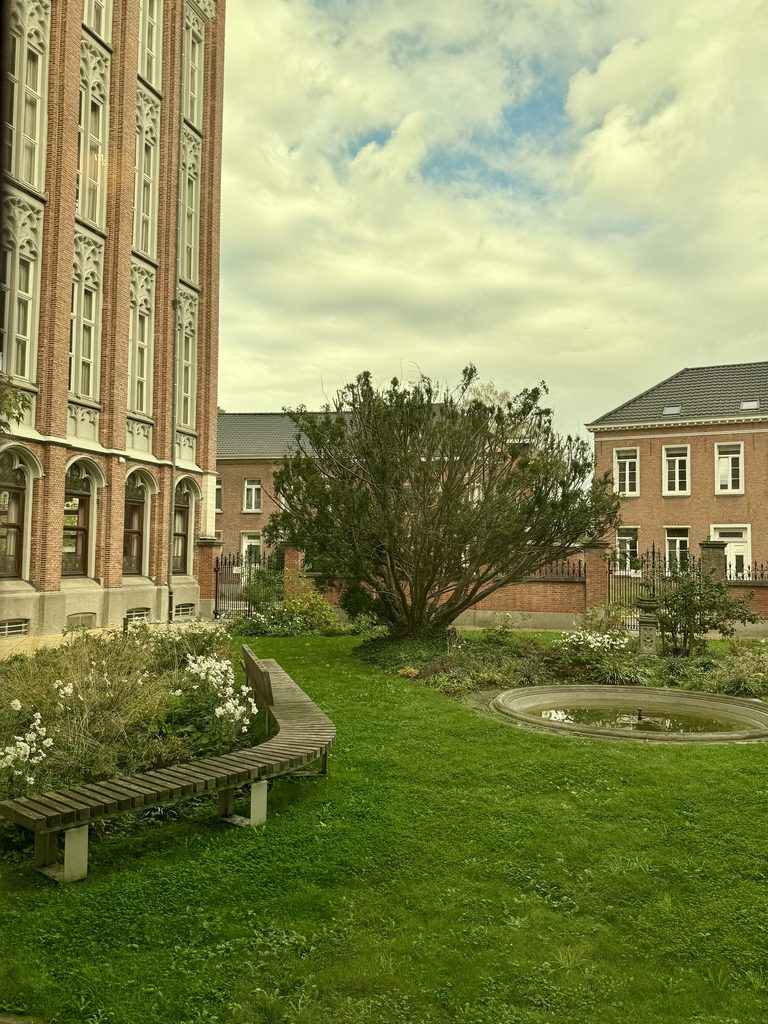
A different view of the gardens. The original girls’ school for local girls was held in this courtyard.
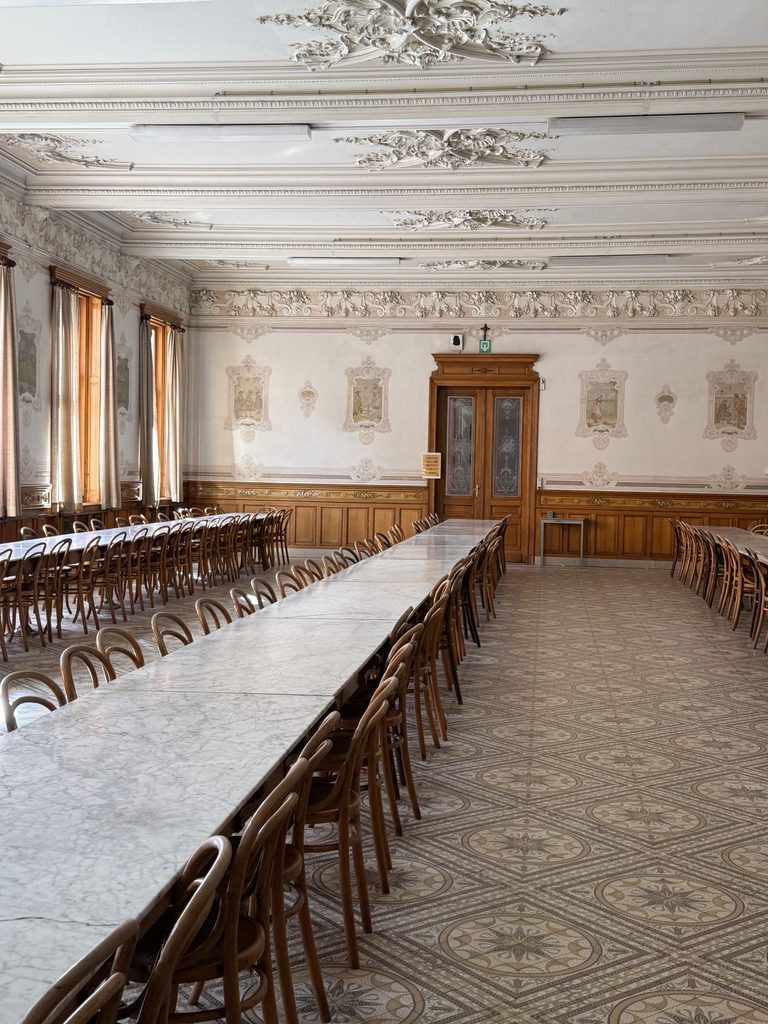
When their parents weren’t around, the girls ate in this canteen.
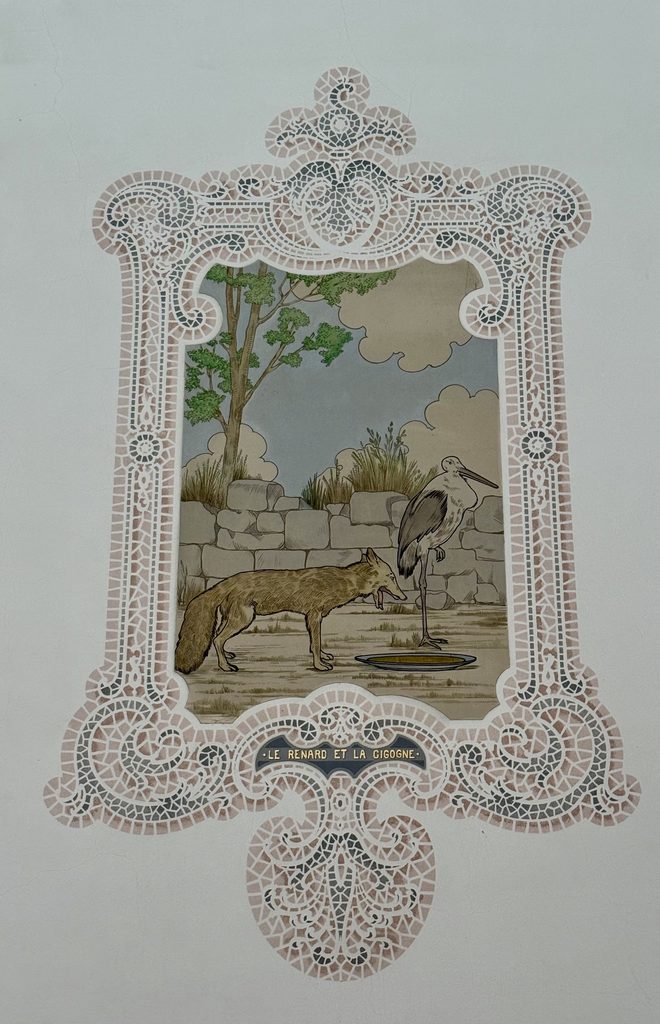
The walls of the canteen were decorated with illustrations from Aesop’s folk tales, such as this one of the Fox and the Stork. Since it’s been a few years since I’ve read Aesop’s Fables, I had to look this one up. The fox invites the stork to dinner, but serves it in a wide flat plate that the fox can lap up easily. The stork, however, can only tap her bill on the plate and ends up going home hungry. The stork is polite, however, and says nothing.
She later invites the fox to her home for dinner, serving a delicious meal in a tall narrow jar with a long neck. She can easily dip her bill inside and enjoy the meal while the fox can only lick the outside of the jar and so he learns what it feels like to be tricked. As in all of Aesop’s Fables, there’s a moral to the story: treat others as you wish to be treated.
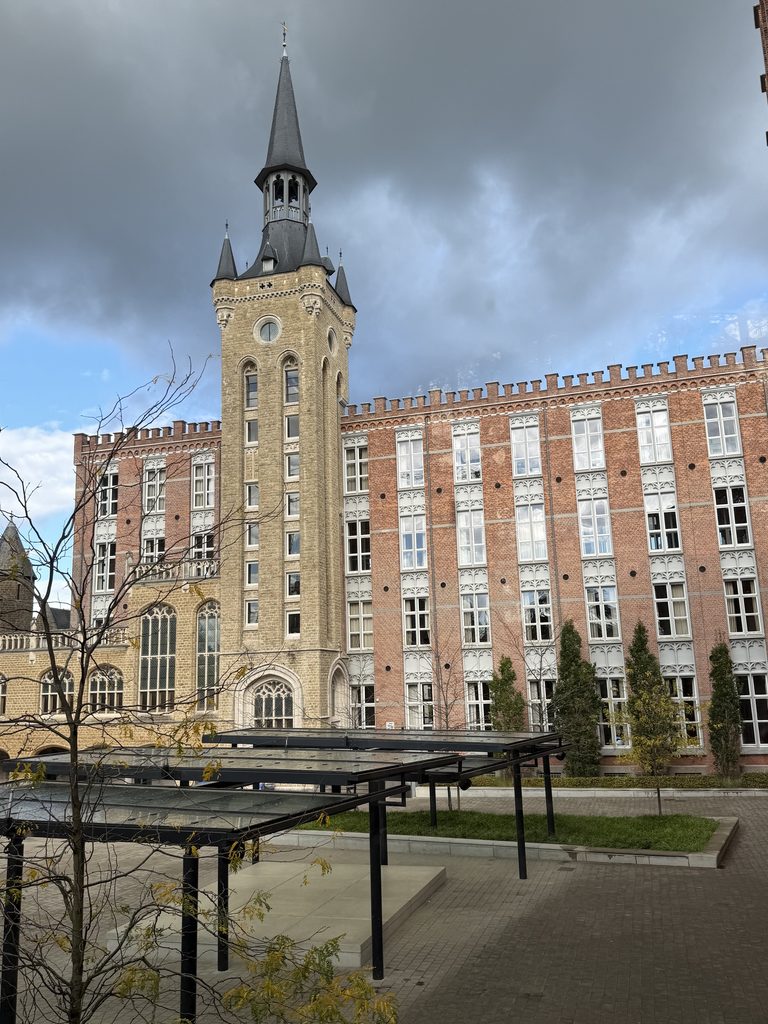
This photo shows what was originally a water tower and dormitory rooms for the boarding students. Since the boarding school was built before indoor plumbing became common, the water tower was needed for washing up, drinking, and cooking. There was a bathroom in the basement where the girls could take baths. Later, when the water tower was no longer necessary, it was converted to a stairway to provide more ways in and out of the building. The former dormitory rooms are now classrooms for the modern-day school.
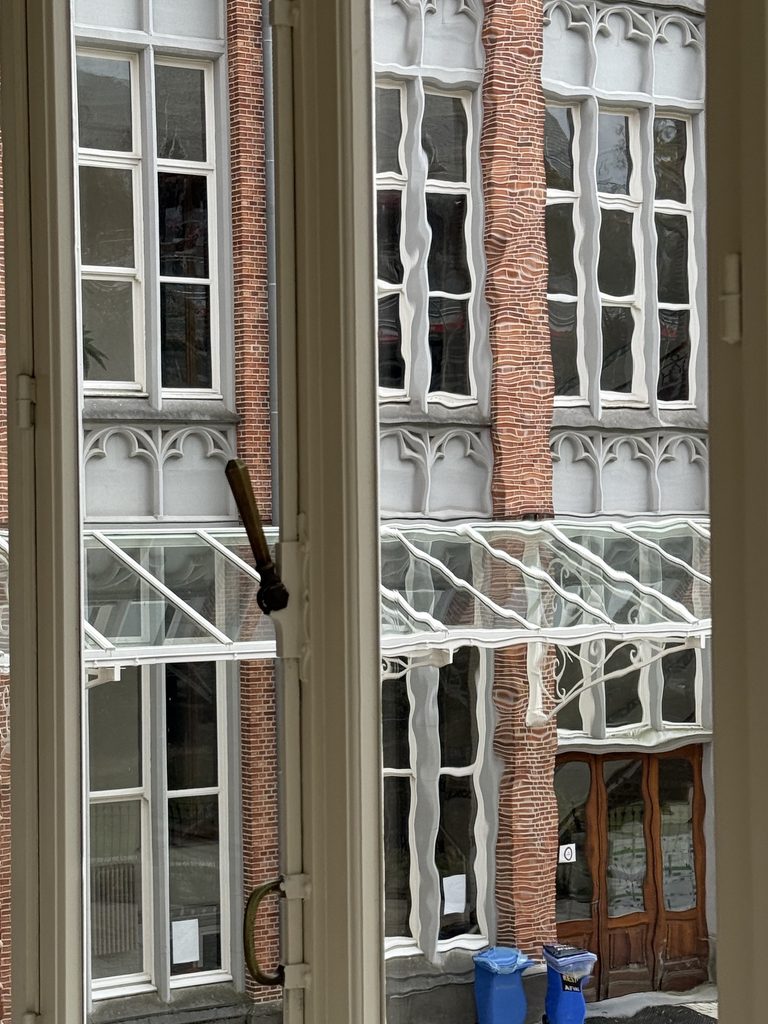
Do you see the wavy lines of the windows on the right? This is original glass from when the school was built, when glass was still hand-rolled flat to form panels. The Usuline Institute suffered damage in both World Wars, so many windows have been replaced with modern machine-made glass (as seen on the left), which doesn’t have the waves and bubbles of the hand-rolled glass.
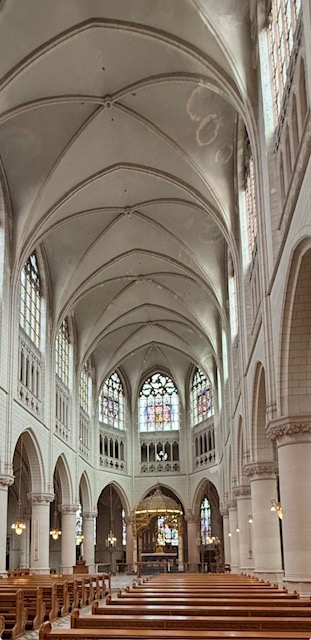
Of course, a Catholic girls’ school needs to have a church. Sadly, the church building has structural damage and is seldom used anymore. The foundation that currently manages the Institute’s buildings doesn’t know when or if they’ll have the funds to make repairs.
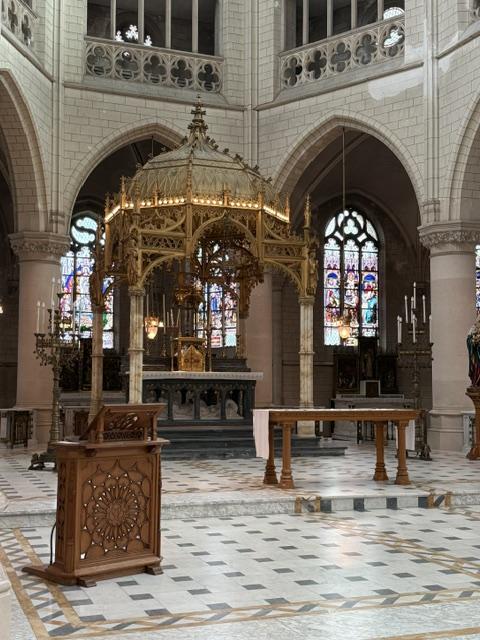
The altar of the church.
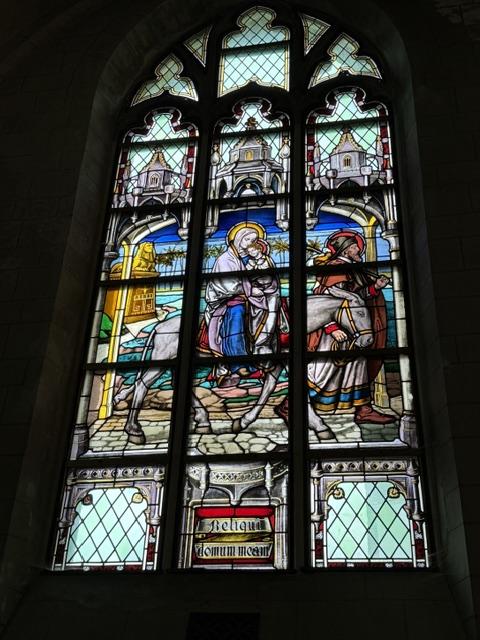
One of many lovely stained glass windows.
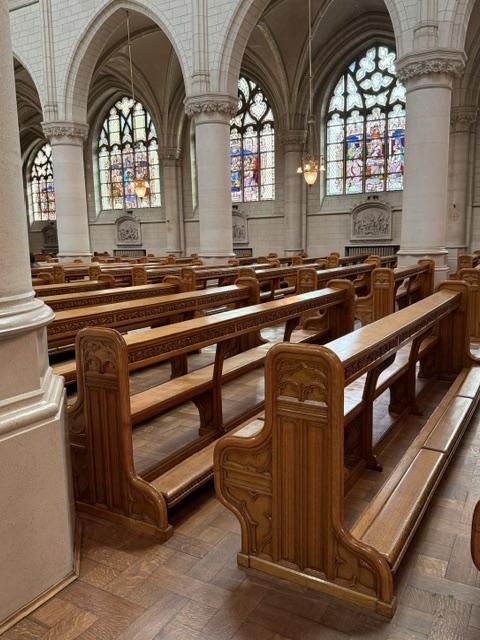
The elegant hand-carved wooden pews.
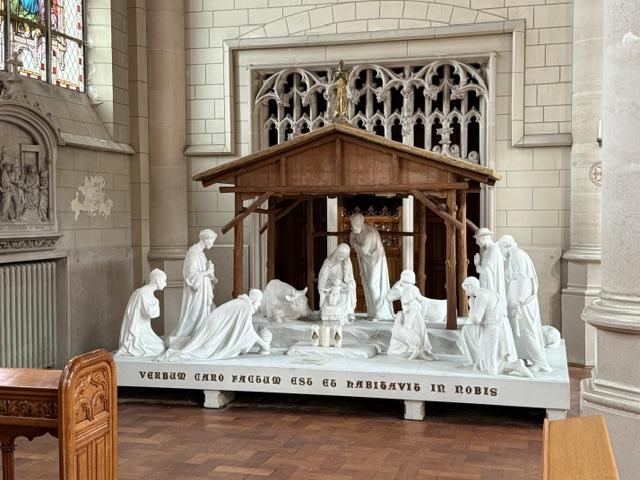
This nativity scene is so old and fragile that they just leave it up year-round.
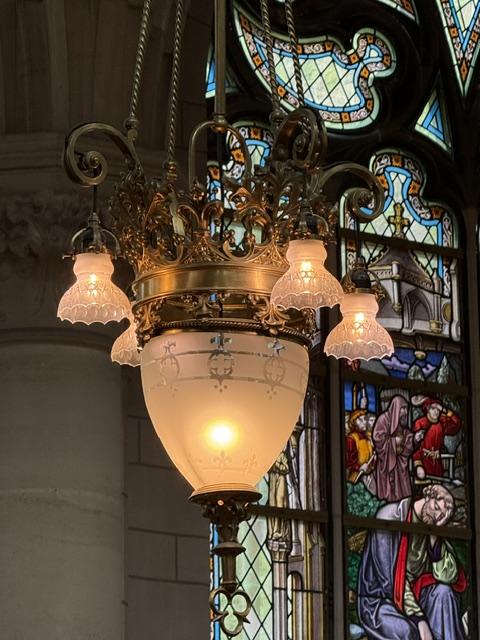
Even the lanterns are elegant.
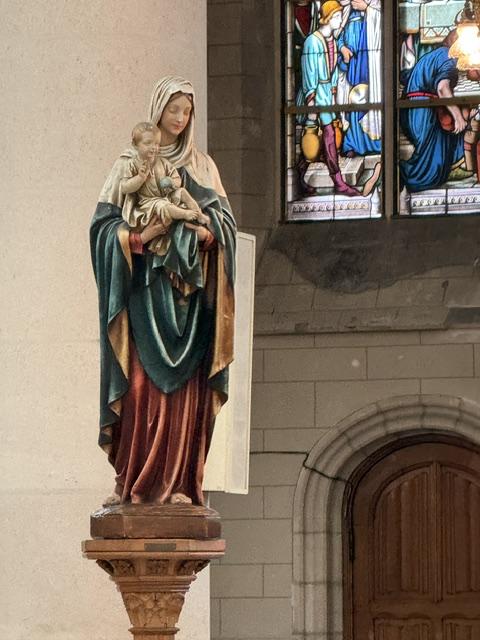
And, of course, no Catholic church would be complete without a statue of the Virgin Mary holding the baby Jesus.
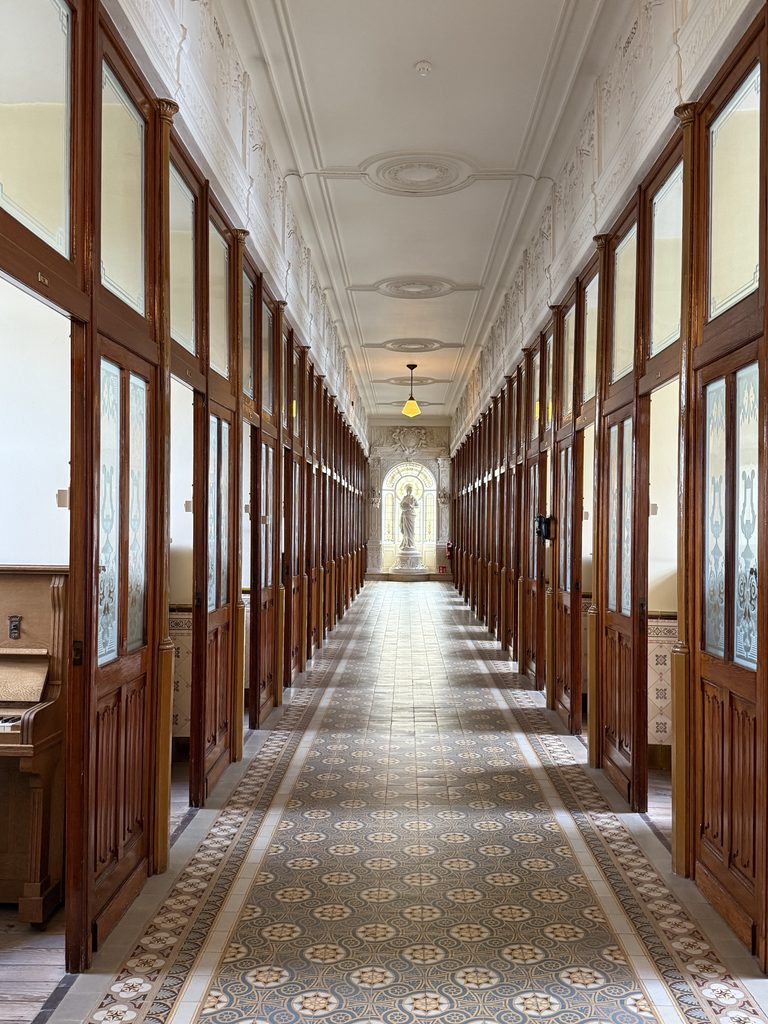
After leaving the church, we visited the piano gallery. Piano instruction was so important in the boarding school that the nuns had 40 practice rooms constructed! Students attending the modern-day school can still practice here during their off-hours.
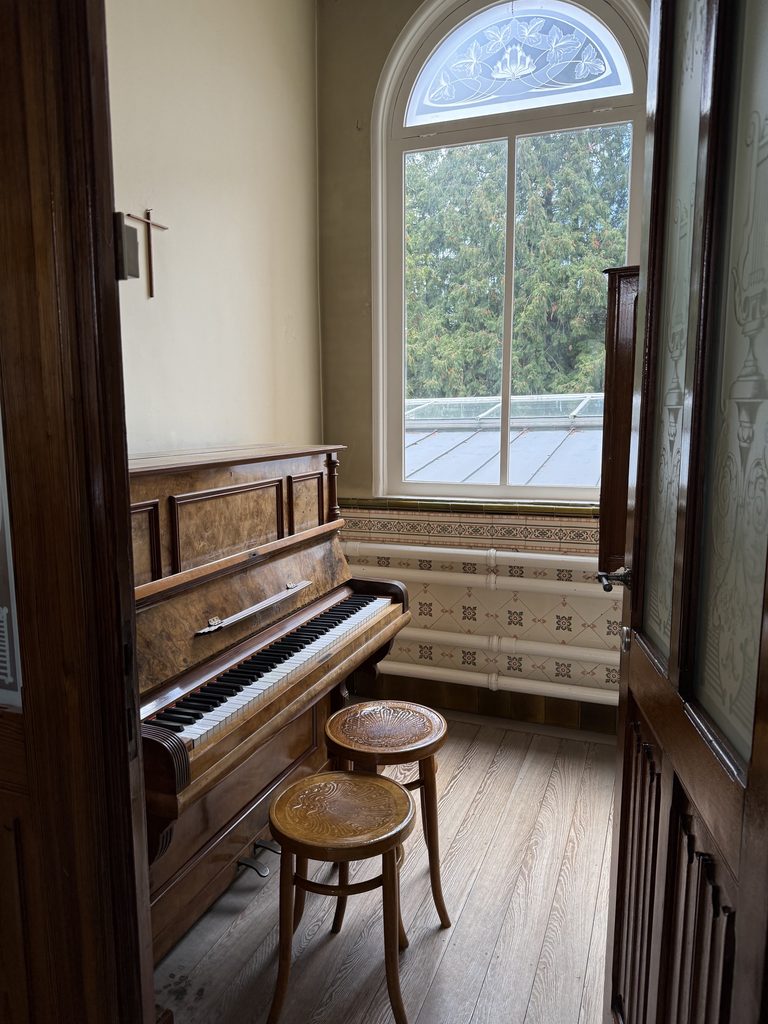
Here’s an example of one of the piano practice rooms. Note that the floors were deliberately made of wood to help dampen sound. The pianos are considered part and parcel of the heritage site, so they cannot be replaced. Therefore, when the pianos cannot be tuned anymore, they just have to sit silent. The practice rooms originally had etched glass covering all the windows, but the ones that were damaged during wartime were simply replaced with modern clear glass.
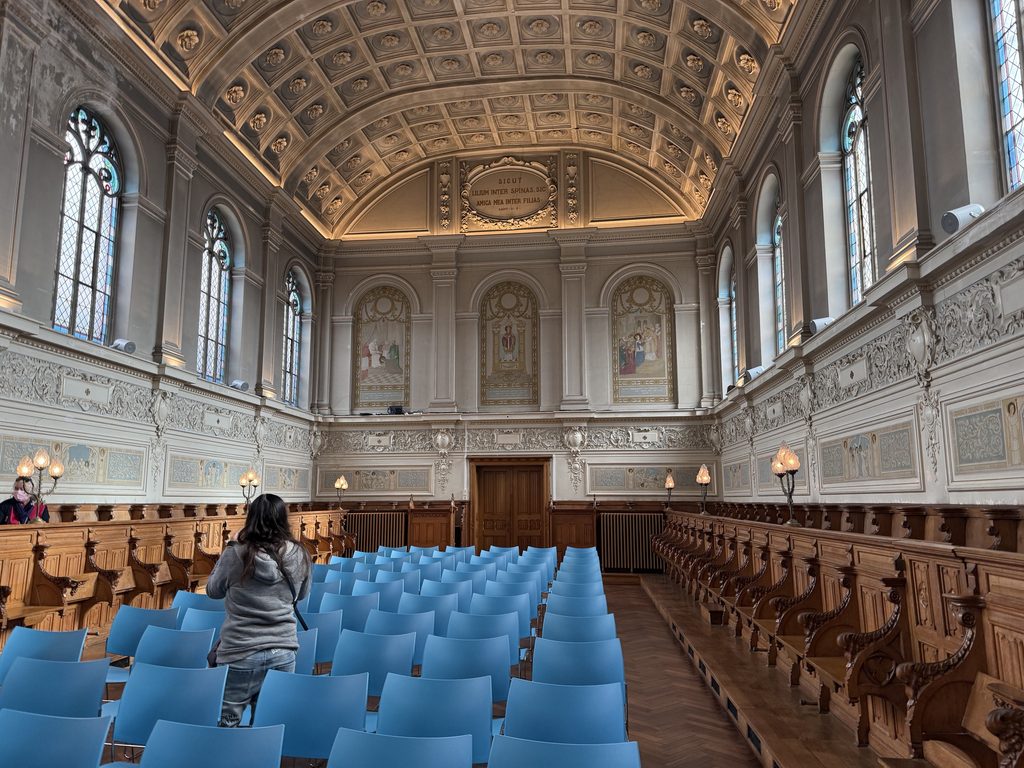
This is the chapel that began being used once the church fell into disuse.
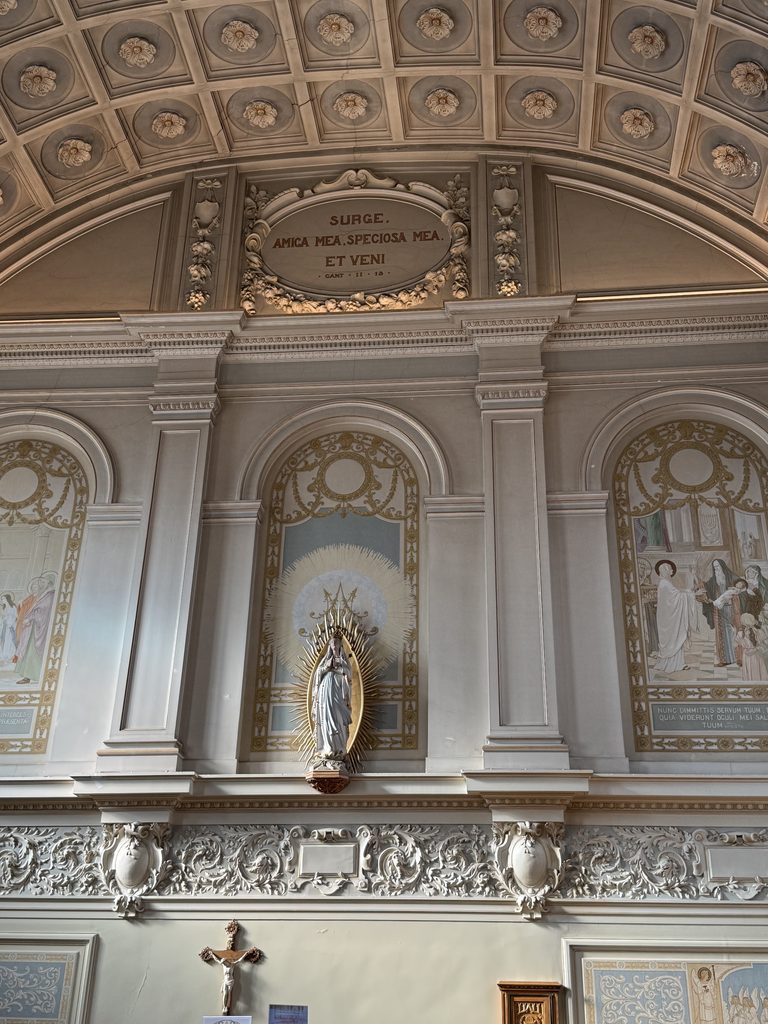
The chapel has some lovely detailing on its walls.
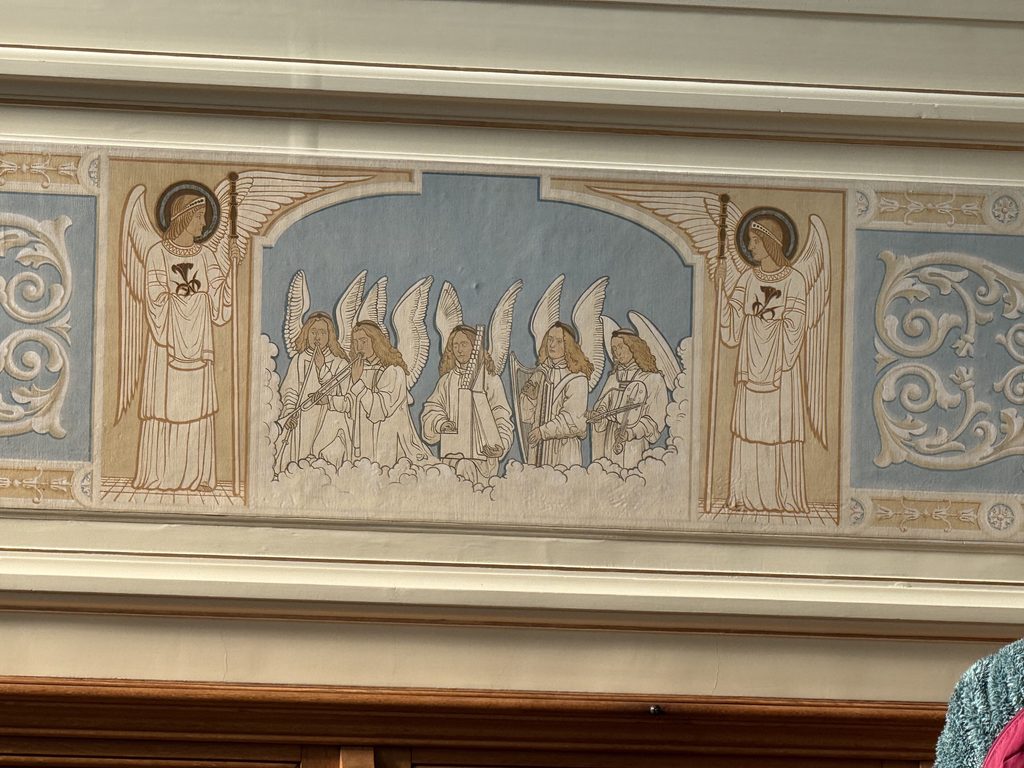
A side panel of angels above the choir stalls.
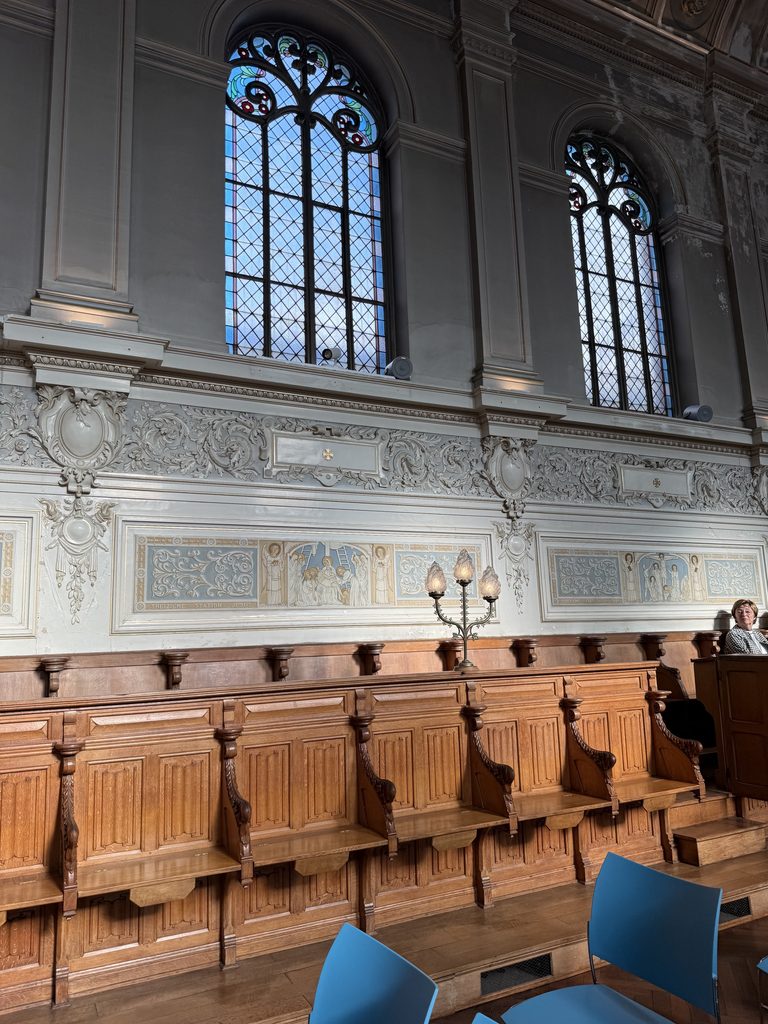
And the choir stalls themselves.
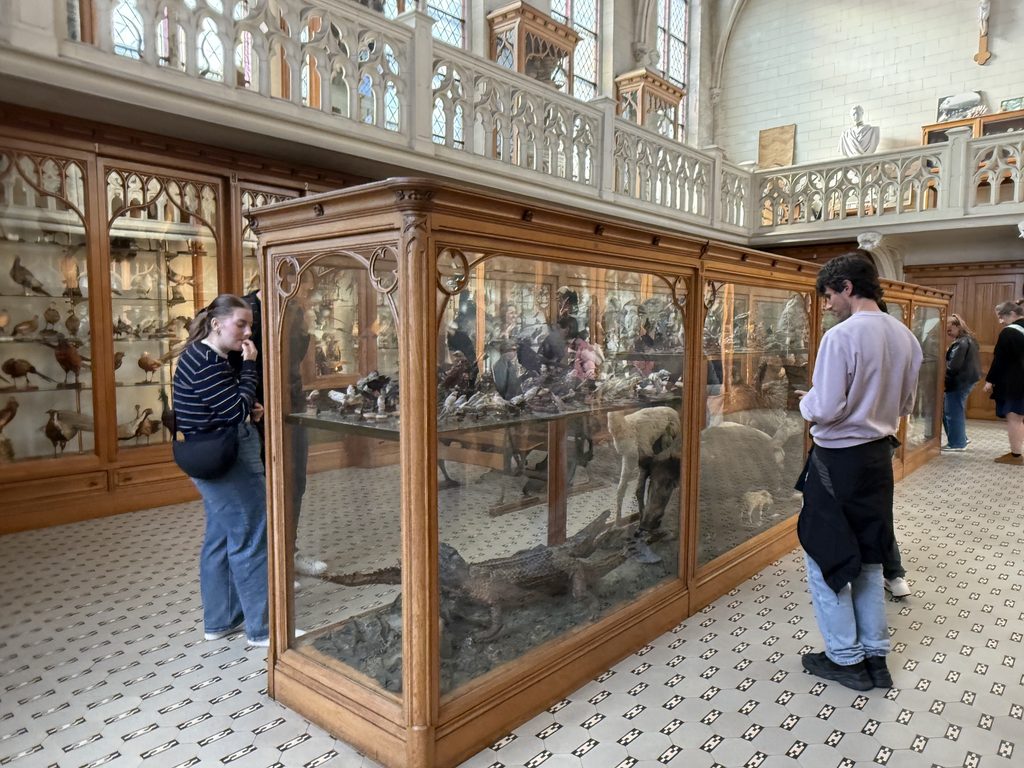
We’re getting close to the end of the tour now. Remember when I said that the girls were taught science as well as the arts? The school even has its own natural history museum, its cases filled with taxidermied birds and mammals of Europe.
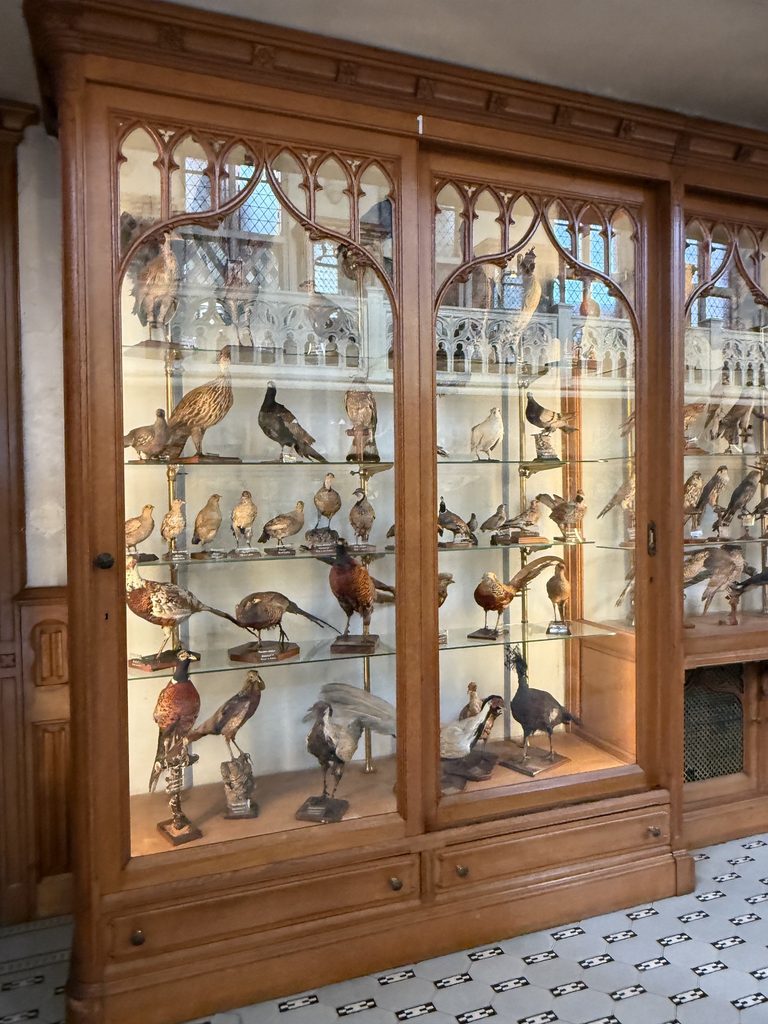
Here’s a museum case of birds.
And the bird cases were even accompanied by sound tracks of the bird calls.
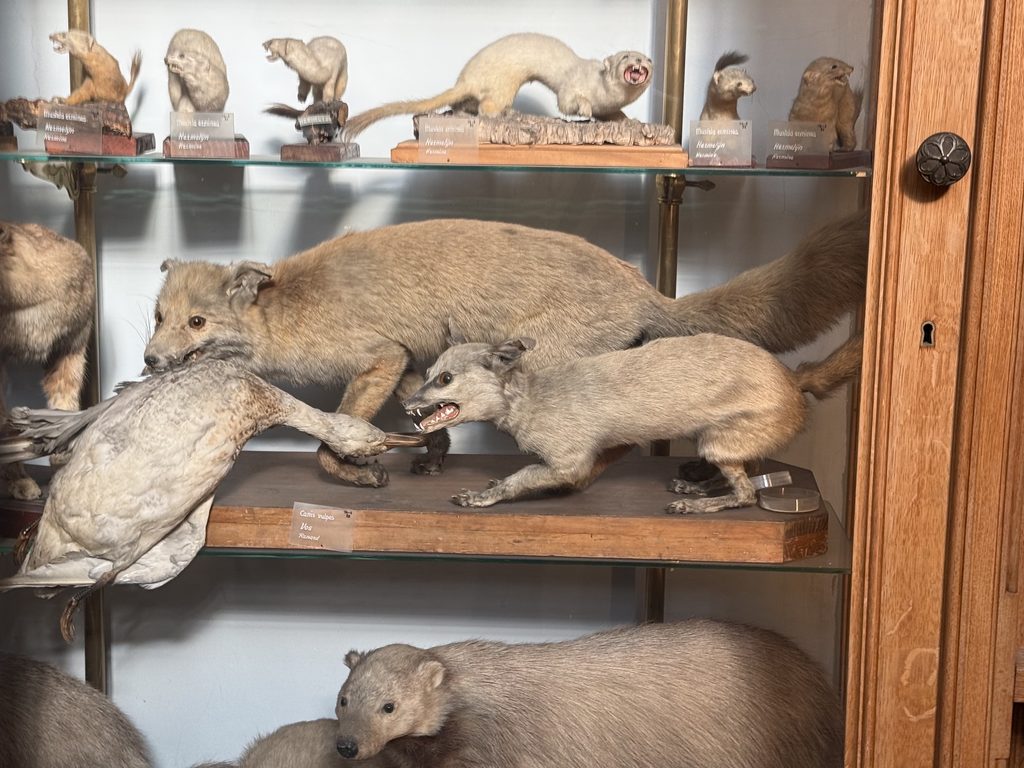
They also included some mammals, such as these foxes obtaining a poultry dinner for themselves.
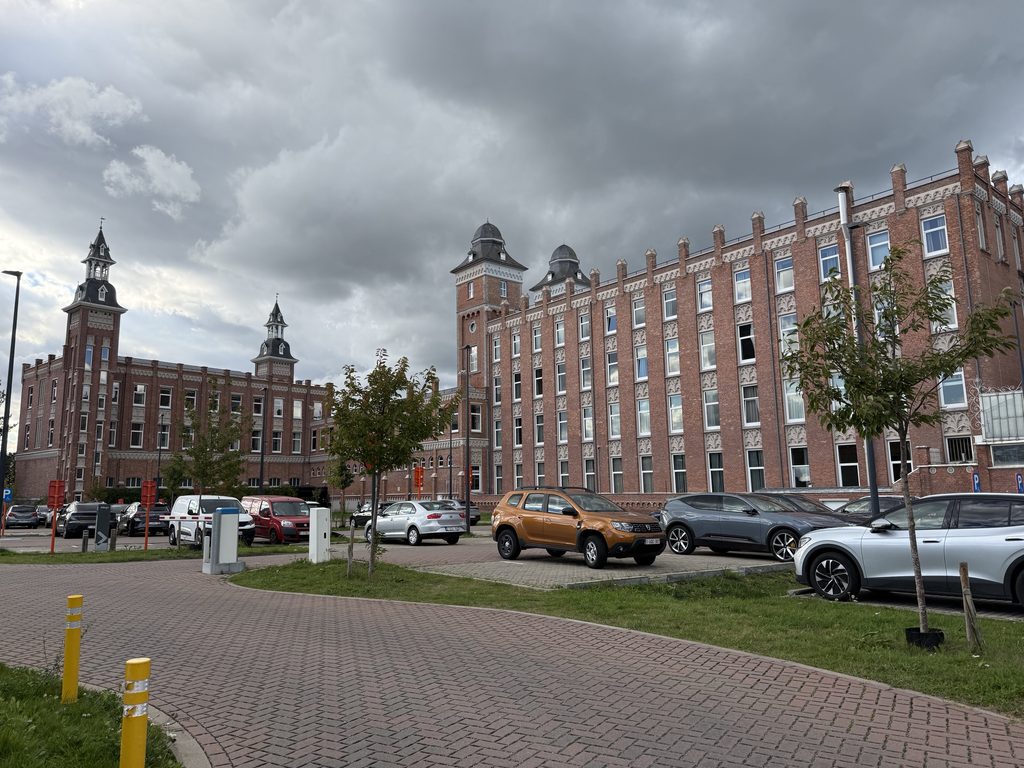
And, finally, a photo of the exterior of Wintertuin, as seen from the parking lot.
Wintertuin has limited visiting hours to ensure that it never gets too crowded. English-language guided tours are only offered on the 1st and 3rd Saturdays of each month, although self-guided tours using an audioguide are available on Wednesday, Friday, Saturday, and Sunday afternoons between 12:30pm and 5:30pm. Note that the tours take about two hours, so it’s advised to arrive no later than 3:30pm. Wintertuin is closed to visitors between December 1st and March 1st each year. Guided tours cost 18 euros and self-guided tours with audioguide are 15 euros.
Joining the sisterhood is a religious vocation that has rapidly dwindled in Belgium in recent decades. There are only eight Ursuline sisters left and all of them are elderly. The sisters created a foundation in 1994 to conserve and protect the buildings.
The boarding school ceased operation in the 1950s and Dutch (the local language of this region) became the language of instruction. Boys began to be admitted. The modern St. Ursula Institute operates, as I understand it, as a public three-year secondary school which doesn’t charge admission fees. It is still a well-regarded school.
Wintertuin is located at Bossstraat 9 in the village of Onze-Lieve-Vrouw-Waver, which roughly translates as Our Lady of the Waves. On maps, you may see it listed as being in Sint-Katelijne Waver. OLV-Waver is roughly six miles northwest of the city of Mechelen. It can be reached by train to Mechelen, and then a bus (#80) to Wintertuin.
St. Ursula was removed from the Catholic Church’s official list of saints in 1969 due to the widely varying legends, plus lack of evidence that she ever existed or that she actually lived a life (and death) of heroic virtue. Nevertheless, the Church of St. Ursula in Cologne (Germany) still honors a number of anonymous virgin martyrs.